AI & Agentic AI
Arabic-First AI: Why Translated English AI Fails in the MENA Market
Jul 01, 2026
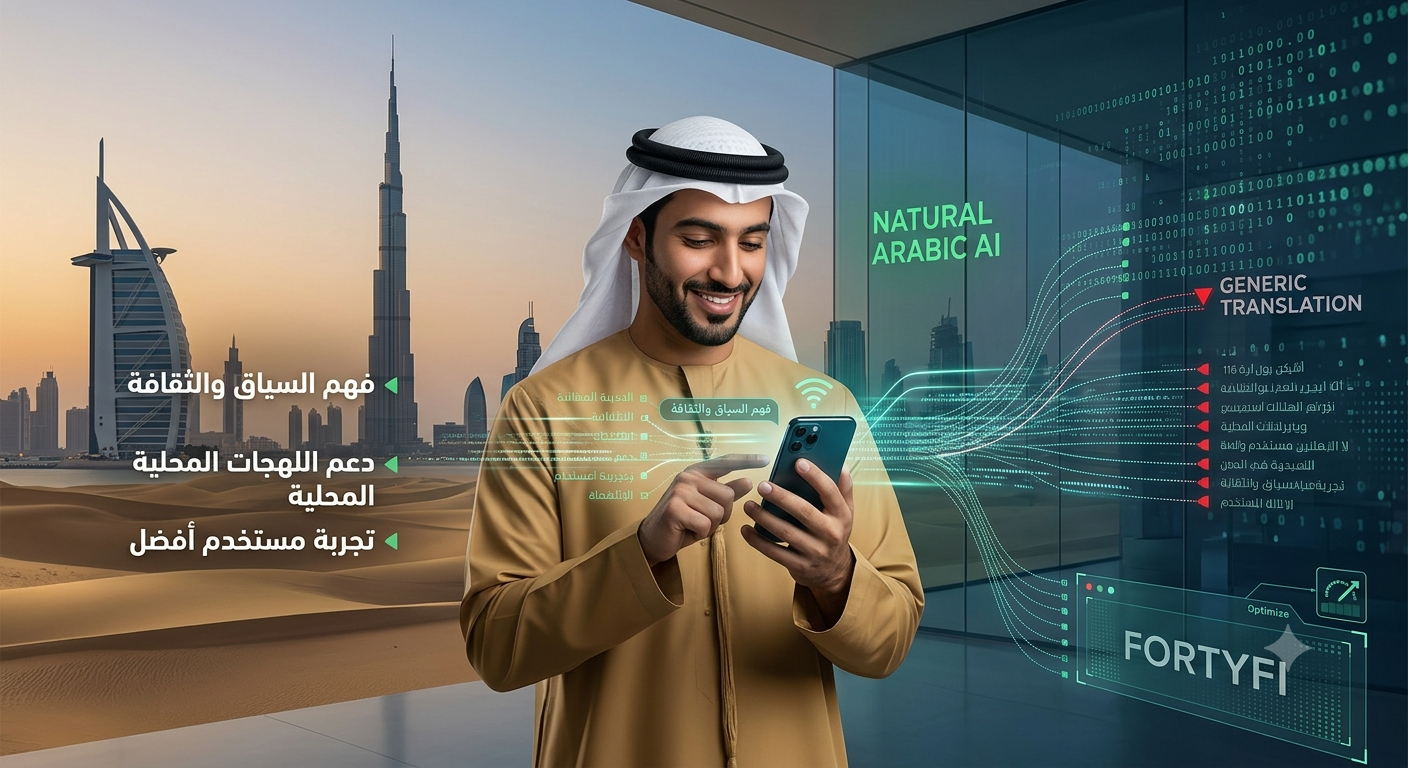
Introduction
AI adoption is accelerating across the Middle East.
Especially in Dubai, the UAE, and the wider GCC.
Businesses are investing heavily in AI to improve customer experience, automate operations,
and unlock competitive advantage.
Chatbots.
Virtual assistants.
Recommendation engines.
Voice AI.
Enterprise automation.
The opportunity is enormous.
But many businesses make a costly mistake.
They build AI systems in English first.
Then translate to Arabic later.
That sounds efficient.
In reality, it often fails.
Because Arabic is not simply English in another script.
Language shapes meaning.
Culture shapes context.
Behavior shapes expectations.
This changes everything.
An AI system that performs well in English may perform poorly in Arabic if it was not designed
for Arabic from the start.
That creates major business risk.
Poor user experience.
Low engagement.
Weak trust.
Reduced adoption.
The question is no longer whether AI matters in the MENA market.
The real question is whether your AI truly understands Arabic users.
The Problem: Translation Alone Does Not Create Localization
Many businesses approach AI localization incorrectly.
They assume translation is enough.
It is not.
Translation changes words.
It does not automatically capture context.
That creates major AI performance issues.
Common challenges with translated English AI include:
● Poor dialect understanding
● Weak contextual accuracy
● Unnatural responses
● Cultural mismatch
● Low user trust
The biggest challenge is linguistic complexity.
Arabic is highly nuanced.
Modern Standard Arabic differs from regional dialects.
User expectations vary across markets.
Intent recognition becomes harder.
Context interpretation becomes harder.
Natural conversation becomes harder.
AI systems built primarily for English often struggle to handle these complexities effectively.
That creates friction.
Users notice quickly.
Poor localization reduces AI performance significantly.
The Solution: Build Arabic-First AI Systems
Strong AI performance in MENA starts with Arabic-first design.
The first layer is language architecture.
AI systems should be trained and optimized specifically for Arabic interactions.
The second layer is contextual intelligence.
Models should understand dialects, user behavior, and regional communication patterns.
The third layer is cultural alignment.
AI must respond in ways that feel natural and relevant.
This is where AI development Dubai, AI consulting Dubai, and LLM implementation GCC
become highly valuable. Businesses need AI systems designed specifically for regional
performance.
The fourth layer is continuous optimization.
Arabic AI systems should improve based on real user interactions and regional usage patterns.
Key Arabic-first AI priorities include:
● Native Arabic capability
● Dialect understanding
● Cultural relevance
● Contextual intelligence
● Continuous optimization
The strongest AI products feel natural to users.
Localization must go beyond translation.
Real Numbers: Generic AI vs Arabic-First AI Investment
Approach Typical
Investment
Business Impact
English-first AI with
translation
AED
50,000–
250,000
Limited regional
performance
Arabic-optimized AI
solution
AED
250,000
–900,000
Stronger engagement
Enterprise Arabic-first
AI platform
AED
900,000
–3M+
Major competitive
advantage
The numbers are clear.
Arabic-first AI requires more upfront investment.
But the business impact is significantly stronger in regional markets.
Better user experience improves adoption.
Trust drives long-term growth.
UAE-Specific Business Considerations
For businesses operating in Dubai and across the UAE, Arabic AI capability is becoming a
major competitive differentiator.
Customer expectations are rising.
Businesses that deliver better Arabic experiences will outperform competitors.
This is where agentic AI UAE and machine learning UAE become critical for long-term AI
success.
Industries likely to benefit most include:
● Banking
● Government services
● Healthcare
● Retail
● Customer support
Key AI priorities include:
● Arabic capability
● User experience
● Localization
● AI performance
● Regional optimization
Businesses targeting MENA users should treat Arabic AI as a strategic priority.
The market demands better localization.
Why FortyFi
FortyFi helps businesses across Dubai and the UAE build advanced AI systems optimized for
real regional performance.
From AI strategy and Arabic-first model design to deployment and optimization, the focus is on
building AI systems users trust and adopt.
The team helps businesses improve AI performance, user experience, and regional market
success.
The objective is simple: build AI that truly understands your market.
FAQ
Why does translated AI fail in MENA?
Translation often misses cultural context, dialects, and user behavior.
What is Arabic-first AI?
It is AI designed specifically for Arabic language and regional usage.
Is Arabic AI harder to build?
Yes. Arabic linguistic complexity makes optimization more challenging.
Which industries need Arabic AI most?
Customer-facing industries benefit the most.
Should businesses prioritize Arabic AI?
Yes. Strong localization improves engagement and adoption.
Does Your AI Truly Understand Arabic Users?
Translation alone is not enough.
Regional intelligence creates competitive advantage.
Businesses that build Arabic-first AI will win the MENA market faster.
Message FortyFi today for an AI strategy assessment and build AI designed for your regional
audience.