Cybersecurity
Building an Internal AI Assistant Trained on Your UAE Company Data
Jul 01, 2026
Introduction
Most companies in the UAE are now experimenting with AI assistants.
But there is a major limitation.
Public AI tools do not know your business.
They don't understand your internal processes.
Your policies.
Your documents.
Your clients.
Or your operational context.
This is why many organizations are moving toward internal AI assistants.
These are AI systems trained on company-specific data.
They act like internal knowledge experts.
Available 24/7.
For employees.
Across departments.
The goal is simple.
Make company knowledge instantly accessible and usable.
But doing this correctly requires more than just plugging documents into a chatbot.
It requires architecture, governance, and secure data design.
The Problem: Company Knowledge Is Fragmented and Hard to Access
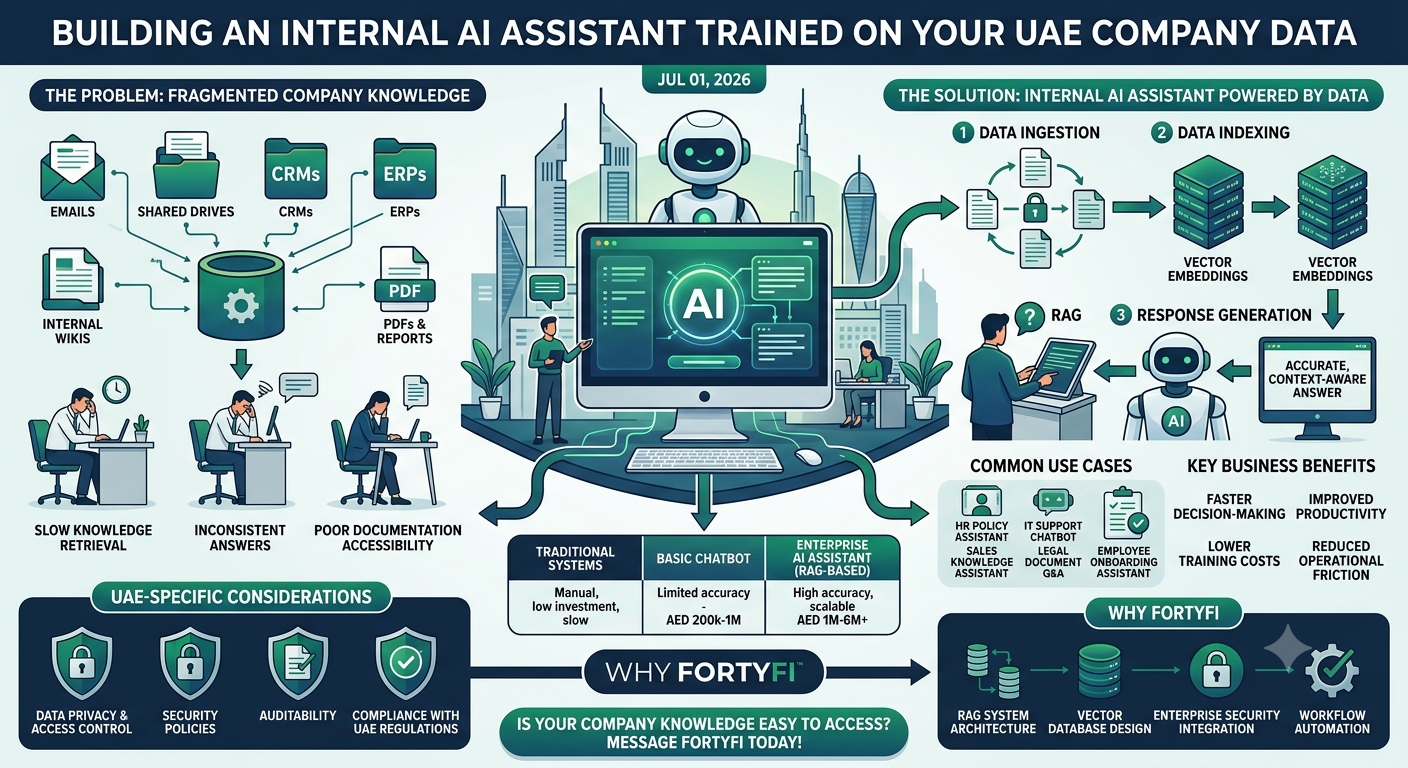
In most UAE enterprises, critical knowledge is scattered across systems.
Emails.
Shared drives.
CRMs.
ERPs.
Internal wikis.
PDFs and reports.
This creates inefficiency.
Employees waste time searching for information.
Or asking colleagues repeatedly.
Common challenges include:
● Slow internal knowledge retrieval
● Inconsistent answers across teams
● Dependence on key individuals
● Poor documentation accessibility
● High onboarding time for new employees
The biggest issue is fragmentation.
Information exists.
But it is not connected.
And not easily searchable in a unified way.
This limits productivity.
And slows down decision-making.
The Solution: Internal AI Assistants Powered by Company Data
Internal AI assistants solve this by centralizing and structuring company knowledge.
The first layer is data ingestion.
All company documents and systems are connected securely.
The second layer is data indexing.
Information is organized into searchable embeddings.
The third layer is retrieval-augmented generation (RAG).
The AI retrieves relevant company context before responding.
The fourth layer is response generation.
The assistant provides accurate, context-aware answers.
This is where AI development Dubai, LLM implementation GCC, and AI consulting Dubai
become essential. Internal AI systems require secure architecture and enterprise-grade
integration.
Common use cases include:
● HR policy assistant
● IT support chatbot
● Sales knowledge assistant
● Legal document Q&A system
● Employee onboarding assistant
Key business benefits include:
● Faster internal decision-making
● Reduced operational friction
● Improved employee productivity
● Lower training costs
● Centralized knowledge access
The strongest enterprises treat internal AI assistants as core infrastructure.
Not optional tools.
Real Numbers: Traditional Knowledge Systems vs AI Assistants
Approach Typical
Investment
Business
Impact
Manual knowledge systems Low
cost
Slow access,
high
dependency
Basic chatbot over documents AED
200,
000
–1M
Limited accuracy
Enterprise internal AI
assistant (RAG-based)
AED
1M–
6M+
High accuracy
and
scalability
The difference is structural.
Not just technological.
AI assistants turn static knowledge into interactive intelligence.
UAE-Specific Business Considerations
For UAE enterprises, internal AI systems must meet strict security and governance
requirements.
This is where agentic AI UAE and machine learning UAE play a key role in ensuring
controlled access to sensitive business data.
Key considerations include:
● Data privacy and access control
● Internal security policies
● Role-based access permissions
● Auditability and logging
● Compliance with UAE data regulations
Industries adopting internal AI assistants include:
● Banking and finance
● Government organizations
● Healthcare systems
● Real estate enterprises
● Large corporate groups
Security is not optional.
It is foundational.
Common Pitfalls in Internal AI Assistant Projects
Many organizations fail to implement internal AI successfully.
1. Poor Data Organization
Unstructured or outdated documents reduce accuracy.
2. No Access Control Layer
Employees accessing data they shouldn't see.
3. Weak Retrieval Systems
Poor indexing leads to irrelevant answers.
4. No Governance Framework
No oversight of AI-generated responses.
5. Over-reliance on raw LLMs
Without company context, accuracy drops significantly.
The solution is structured RAG architecture.
Not simple chatbot deployment.
The Fix: Enterprise-Grade Internal AI Architecture
A strong internal AI assistant includes:
1. Secure data ingestion layer
Connects all enterprise systems safely.
2. Vector-based knowledge retrieval
Enables semantic search across documents.
3. Role-based access control
Ensures users only see authorized information.
4. RAG-powered response generation
Combines LLMs with internal knowledge.
5. Monitoring and feedback loops
Continuously improves answer quality.
This architecture ensures accuracy, safety, and scalability.
Why FortyFi
FortyFi helps UAE organizations design and implement secure internal AI assistants powered
by company data.
From RAG system architecture and vector database design to enterprise security integration
and workflow automation, the focus is on building reliable internal intelligence systems.
The team helps businesses transform scattered knowledge into structured AI-powered
assistants.
The objective is simple: make company knowledge instantly accessible and secure.
FAQ
What is an internal AI assistant?
An AI system trained on company-specific data for internal use.
Is it different from ChatGPT?
Yes. It uses private company data and controlled access.
What technology powers it?
Usually RAG + vector databases + LLMs.
Is it secure?
Yes, when properly designed with access controls.
What are the benefits?
Faster access to knowledge and improved productivity.
Is Your Company Knowledge Easy to Access?
Your data already exists.
But is it usable?
Internal AI assistants turn knowledge into action.
Message FortyFi today for an internal AI assistant assessment and unlock your company
intelligence.