Cybersecurity
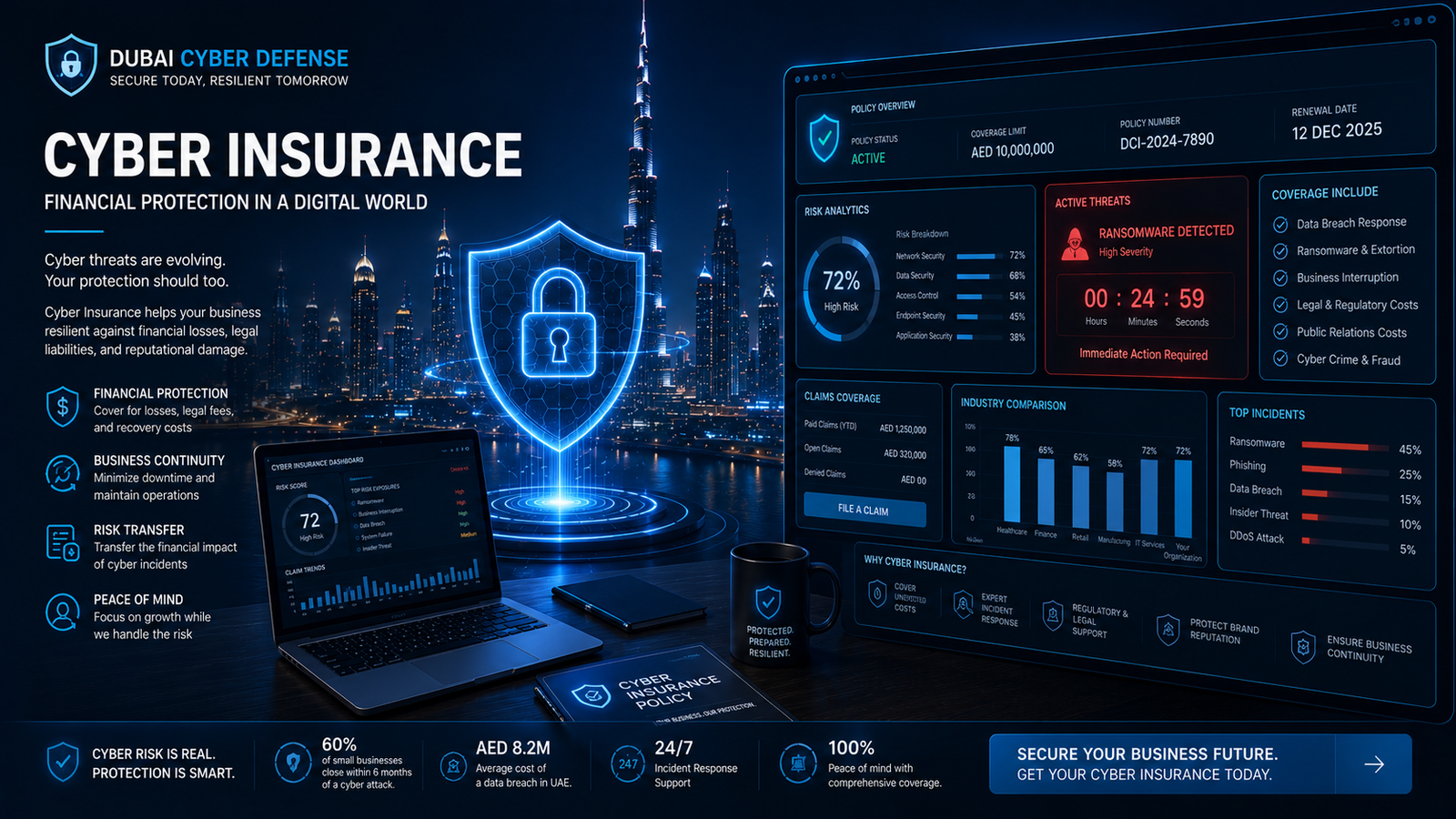
Cyber Insurance in the UAE: What It Covers and What It Won’t
Jun 30, 2026
Introduction
As cyber attacks continue to rise across Dubai and the UAE, more businesses are turning to cyber insurance as part of their risk management strategy.
The appeal is understandable.
A serious cyber incident can create major financial damage. Ransomware, business interruption, data breaches, fraud, and recovery costs can quickly escalate into hundreds of thousands—or even millions—of dirhams.
Cyber insurance offers financial protection.
But many business leaders misunderstand what it actually covers.
Some assume cyber insurance will fully protect them from any cyber-related loss. Others treat it as a replacement for strong cyber security controls.
Both assumptions are dangerous.
Cyber insurance is an important financial safety net, but it is not a substitute for security. Policies have limits, exclusions, conditions, and coverage gaps.
The key question is not whether cyber insurance matters.
The real question is whether your business truly understands what it is buying.
The Problem: Many Businesses Overestimate Coverage
Cyber insurance can reduce financial exposure, but coverage is rarely unlimited.
Policies vary significantly between providers.
This creates confusion.
A policy may cover ransomware recovery but exclude ransom payments. Another may cover legal costs but limit business interruption claims. Some policies exclude incidents caused by weak security controls or employee negligence.
The biggest issue is expectation mismatch.
Businesses often discover coverage limitations only after a major incident.
By then, it is too late.
Another growing challenge is insurer requirements.
Insurance providers increasingly require businesses to demonstrate baseline security controls such as Multi-Factor Authentication, endpoint protection, secure backups, and incident response planning.
Weak security can lead to denied claims or reduced payouts.
Cyber insurance works best when businesses understand both coverage and limitations.
The Solution: Combine Insurance with Strong Security
Cyber insurance should be treated as one layer of a broader risk management strategy.
The strongest approach combines financial protection with strong preventive security controls.
This starts with understanding common coverage categories.
Most cyber insurance policies may include:
● Incident response and forensic investigation
● Data breach recovery costs
● Business interruption losses
● Legal and regulatory expenses
● Customer notification costs
● Cyber extortion support
However, exclusions are equally important.
Common exclusions may include:
● Poor security hygiene
● Known vulnerabilities left unpatched
● Insider misconduct
● Policy violations
● Certain third-party failures
This is why businesses investing in cyber security Dubai strategies gain two major advantages.
They reduce breach risk.
They also improve insurability.
Controls such as SOC as a service UAE, MFA, endpoint protection, and incident response planning improve both security posture and policy eligibility.
Insurance works best when combined with strong security readiness.
Real Numbers: Insurance vs Incident Cost
Approach | Typical Annual Cost | Business Impact
No cyber insurance | AED 0 upfront | Full financial exposure
Basic cyber insurance | AED 15,000–50,000 | Moderate financial protection
Advanced coverage + strong security | AED 50,000–200,000 | Strong risk reduction and resilience
The numbers highlight the value.
Cyber insurance premiums are often far lower than the financial damage caused by a major cyber incident.
However, the value depends entirely on having the right coverage and meeting policy requirements.
A policy is only useful if claims are valid.
Understanding terms matters.
UAE-Specific Security Considerations
For businesses operating in Dubai and across the UAE, cyber insurance is becoming increasingly relevant as regulatory expectations and threat activity continue to grow.
Incidents involving sensitive customer data may trigger obligations under PDPL compliance UAE and broader data protection UAE requirements.
Insurance can help with financial recovery, but compliance responsibility remains with the business.
Key risk management priorities include:
● Security control maturity
● Incident response readiness
● Data protection controls
● Business continuity planning
● Compliance preparedness
Insurance strengthens resilience, but it does not eliminate risk.
Security still comes first.
Why FortyFi
FortyFi helps businesses across Dubai and the UAE strengthen cyber resilience through practical security strategies that improve both protection and insurability.
From risk assessments and security control implementation to incident response planning and continuous monitoring, the focus is on reducing cyber risk before incidents occur.
The team helps businesses build stronger security foundations that support both operational resilience and insurance readiness.
The objective is simple: reduce risk before relying on insurance.
FAQ
What is cyber insurance?
Cyber insurance provides financial protection against certain cyber-related incidents and losses.
Does cyber insurance cover ransomware?
Some policies do, but coverage varies significantly between providers.
Can insurers deny claims?
Yes. Claims may be denied if businesses fail to meet policy requirements or maintain required security controls.
Does cyber insurance replace cyber security?
No. Insurance complements security but does not replace it.
Is cyber insurance important for SMBs?
Yes. SMBs can face significant financial exposure from cyber incidents.
Is Your Business Properly Protected—or Just Assuming It Is?
Cyber insurance can provide valuable financial protection.
But coverage is only one part of the equation.
Businesses with weak security remain highly vulnerable.
The strongest protection combines cyber insurance with strong security controls.
Message FortyFi today for a cyber risk assessment and strengthen your business before the next major incident.