Cybersecurity
Disaster Recovery vs Backup: What UAE Businesses Confuse and Why It Matters
Jul 01, 2026
Introduction
Many businesses across Dubai and the UAE believe they are protected from outages,
ransomware, and cyber incidents because they have backups.
That assumption creates a dangerous risk.
Backups are important.
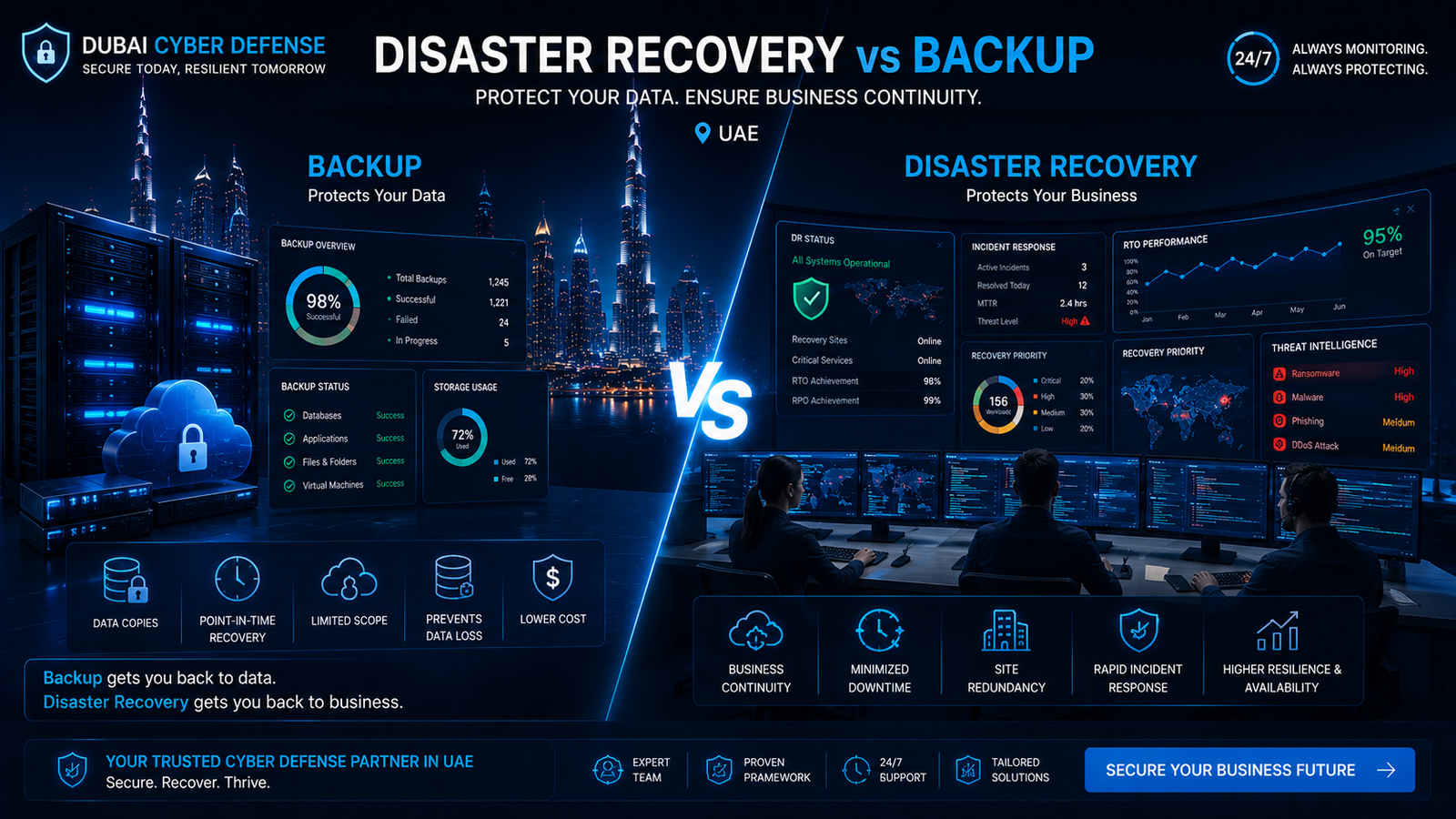
But backups alone are not disaster recovery.
And confusing the two can create serious operational exposure.
This misunderstanding is more common than many business leaders realize. A company may
invest in regular backups, cloud storage, or redundant systems and assume business continuity
is covered.
But during a real crisis, they often discover major gaps.
Critical systems remain offline.
Recovery takes too long.
Operations stop.
Revenue suffers.
Customers lose trust.
The problem is simple.
Backups help recover data.
Disaster recovery helps restore business operations.
Both matter.
The question is no longer whether disruptions will happen.
The real question is whether your business can recover fast enough when they do.
The Problem: Backup Alone Does Not Guarantee Recovery
Many businesses invest in backups without fully understanding recovery.
This creates false confidence.
A backup simply means copies of data exist somewhere.
That is useful.
But during a ransomware attack, infrastructure failure, cloud outage, or cyber incident, restoring
data alone may not restore operations quickly enough.
That is the core issue.
Recovery requires much more than data availability.
Businesses need systems, applications, network access, infrastructure, and operational
processes restored in the correct order.
Common business disruptions include:
● Ransomware attacks
● Server failures
● Cloud outages
● Data corruption
● Human error
Without a structured recovery plan, downtime can escalate quickly.
Even businesses with good backups may struggle to recover operations within acceptable
timelines.
That creates severe business risk.
Downtime often becomes more expensive than the incident itself.
The Solution: Build Backup and Disaster Recovery Together
The strongest resilience strategy combines reliable backups with practical disaster recovery
planning.
The first layer is backup protection.
Critical data should be backed up regularly, securely, and tested for recovery.
The second layer is recovery planning.
Businesses need clear processes for restoring systems, applications, and business operations
during incidents.
The third layer is testing.
Recovery plans should be tested regularly to validate timelines and identify weaknesses.
This is where cyber security Dubai strategies such as resilience planning and SOC as a
service UAE provide strong value. Early threat detection and rapid incident response
significantly improve recovery outcomes.
Key recovery metrics include:
● Recovery Time Objective (RTO)
● Recovery Point Objective (RPO)
● Downtime tolerance
● Critical system prioritization
The strongest businesses plan for failure before it happens.
Preparedness creates resilience.
Real Numbers: Recovery Planning vs Downtime Cost
Approach Typical Annual
Cost
Business Impact
Basic backups only AED
5,000–20,000
Limited recovery
capability
Backup + basic disaster
recovery
AED
25,000–80,00
0
Improved recovery
readiness
Advanced resilience
program
AED
80,000–250,0
00
Strong business
continuity
The numbers tell a clear story.
The cost of strong recovery planning is significantly lower than prolonged downtime caused by
outages, ransomware, or infrastructure failure.
Downtime is expensive.
Recovery speed matters.
UAE-Specific Security Considerations
For businesses operating in Dubai and across the UAE, resilience planning affects both
operational continuity and compliance readiness.
Data loss or prolonged downtime involving sensitive systems can impact PDPL compliance
UAE and broader data protection UAE obligations.
Key resilience priorities include:
● Backup reliability
● Recovery speed
● Infrastructure resilience
● Incident response readiness
● Business continuity planning
Businesses handling critical systems or sensitive data should treat recovery planning as
essential.
Operational resilience is a competitive advantage.
Why FortyFi
FortyFi helps businesses across Dubai and the UAE strengthen cyber resilience through
practical backup, disaster recovery, and incident response strategies.
From resilience assessments and backup validation to disaster recovery planning and threat
monitoring, the focus is on reducing downtime and improving recovery outcomes.
The team helps businesses improve preparedness, strengthen resilience, and recover faster
during disruptions.
The objective is simple: ensure business continuity when incidents happen.
FAQ
Are backup and disaster recovery the same?
No. Backups protect data, while disaster recovery restores business operations.
Why are backups alone not enough?
Data recovery alone may not restore systems and operations quickly enough.
What is RTO?
Recovery Time Objective defines how quickly systems must be restored.
What is RPO?
Recovery Point Objective defines acceptable data loss between backups.
Does recovery planning help compliance?
Yes. Strong resilience improves security posture and compliance readiness.
Could Your Business Recover Fast Enough During a Major Incident?
Having backups is important.
But recovery requires much more than stored data.
Businesses that prepare recovery strategies before disruption recover faster and reduce losses.
Message FortyFi today for a resilience assessment and strengthen your disaster recovery
readiness