Cybersecurity
EDR vs SIEM vs DLP: Which Security Tools Does Your UAE Business Actually Need?
Jun 30, 2026
Introduction
As cyber threats grow more sophisticated, businesses across Dubai and the UAE are investing
more in cyber security than ever before. The challenge is not only deciding whether to invest.
The bigger challenge is knowing where to invest.
Many business leaders hear terms like EDR, SIEM, and DLP in security discussions, vendor
presentations, and compliance meetings. The problem is that these tools often sound similar,
creating confusion around what they actually do and which ones deliver the most value.
The result is often unnecessary spending, overlapping tools, or critical security gaps.
Choosing the right security tools is not about buying everything. It is about understanding your
business risks, compliance obligations, and operational priorities.
The right tools can dramatically reduce risk, improve visibility, and strengthen your overall
security posture. The wrong choices create cost without meaningful protection.
The Problem
The cyber security market is crowded with tools, platforms, and vendors promising complete
protection. For many businesses, especially SMBs, this creates decision paralysis.
EDR, SIEM, and DLP solve different problems, yet many organizations treat them as
interchangeable.
This creates major gaps.
A business may invest heavily in endpoint security but fail to monitor network-wide threats.
Another may deploy advanced monitoring but overlook sensitive data leakage risks.
Without a clear strategy, security investments become fragmented.
The challenge becomes even more important for UAE businesses dealing with PDPL
compliance UAE, where protecting personal and sensitive data is both a security and
regulatory requirement.
The goal is not to collect tools.
The goal is to build meaningful protection against real business risks.
The Solution
The best way to choose the right tools is by understanding the role each one plays in your
security architecture.
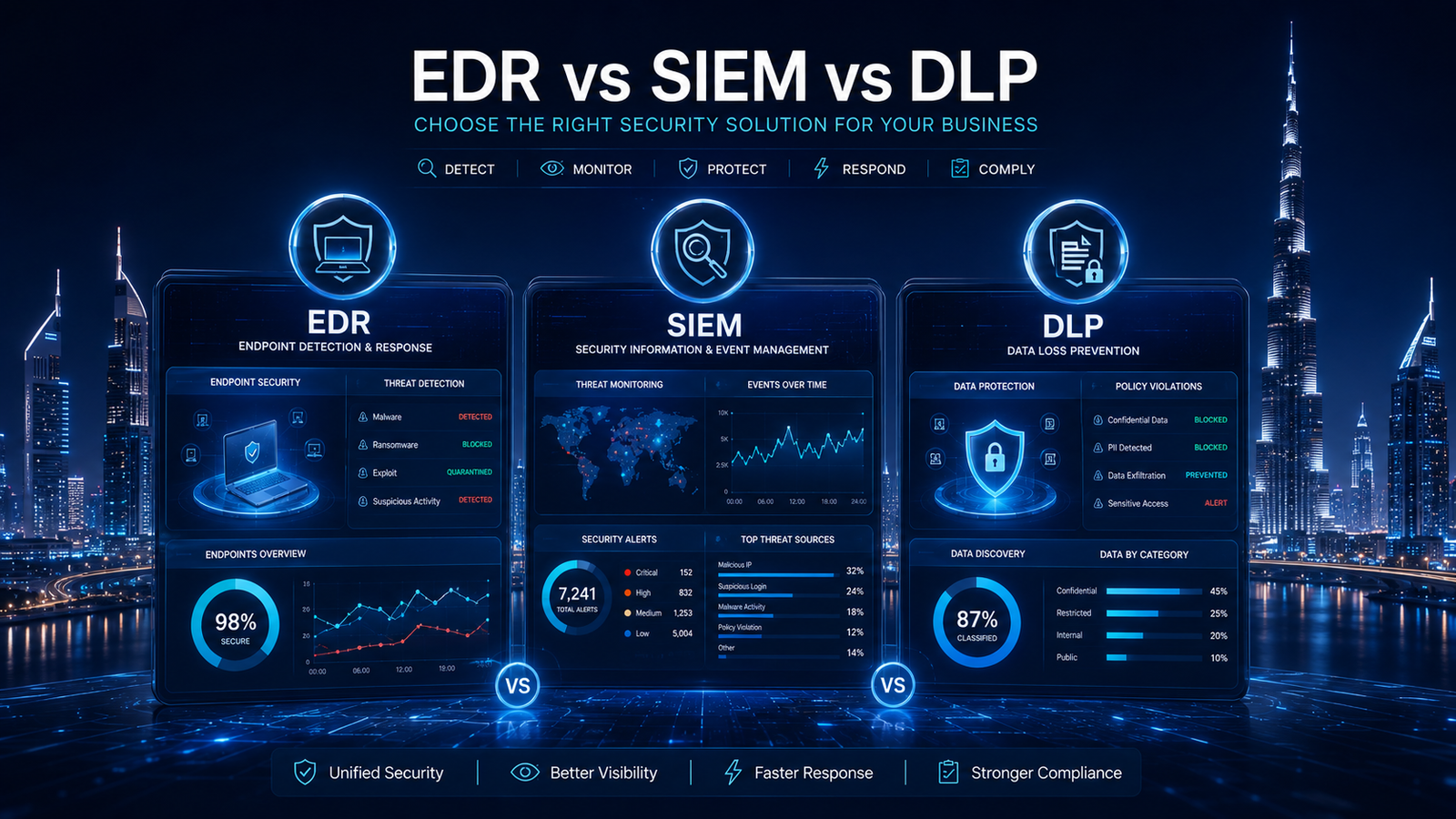
EDR (Endpoint Detection and Response)
EDR focuses on protecting devices such as laptops, desktops, and servers.
It continuously monitors endpoints for suspicious behavior, malware activity, ransomware
attacks, and unusual system activity. EDR enables fast detection and response when threats
target individual devices.
For most businesses, EDR is one of the strongest first-line defenses.
SIEM (Security Information and Event Management)
SIEM collects and analyzes security logs from across your infrastructure, including endpoints,
cloud systems, applications, and networks.
It provides centralized visibility into suspicious activity and helps security teams identify threats
that may not be visible from individual tools alone.
SIEM becomes especially powerful when combined with SOC as a service UAE, where experts
actively monitor and respond to alerts.
This tool is ideal for businesses needing stronger monitoring and faster incident detection.
DLP (Data Loss Prevention)
DLP focuses on protecting sensitive business and customer data.
It helps prevent unauthorized access, accidental exposure, or intentional theft of confidential
information such as financial records, personal data, contracts, and internal documents.
For businesses handling sensitive information, DLP plays a critical role in strengthening data
protection UAE.
This is especially important for compliance-driven sectors like finance, healthcare, and
e-commerce.
Real Numbers
The right choice depends on business needs.
For many SMBs, EDR is the best starting point because endpoint attacks are common and
costly.
As businesses scale, SIEM improves visibility across infrastructure.
Businesses handling sensitive customer or financial data benefit significantly from DLP.
In many cases, the strongest protection comes from combining all three strategically.
UAE Specific Considerations
Businesses operating in Dubai and across the UAE must align security decisions with both
threat protection and regulatory requirements.
This includes cyber security Dubai priorities such as threat monitoring, breach detection, and
incident response, as well as compliance obligations under PDPL.
Important priorities include:
● Endpoint threat detection
● Infrastructure-wide monitoring
● Sensitive data protection
● Access control and identity management
● Incident response readiness
Security tools should support both business resilience and compliance readiness.
Choosing tools without considering regulatory requirements often creates long-term risk.
Why FortyFi
FortyFi helps businesses across Dubai and the UAE design security architectures based on real
business needs—not unnecessary complexity.
From endpoint security and monitoring to advanced threat detection and compliance support,
the focus is on practical security strategies that reduce risk and improve resilience.
The team helps businesses evaluate tools like EDR, SIEM, and DLP to build right-sized security
programs that align with business goals and compliance requirements.
The objective is simple: deploy smarter security, not just more security
FAQ
What is the difference between EDR and SIEM?
EDR protects endpoints like laptops and servers, while SIEM provides centralized visibility
across all systems and security logs.
Do SMBs need SIEM?
Not always. Smaller businesses often start with EDR and basic monitoring before moving to
SIEM.
Is DLP required for PDPL compliance?
DLP is not always mandatory, but it significantly improves protection of sensitive data and
supports compliance efforts.
Which tool should businesses buy first?
For most SMBs, EDR is typically the best first investment.
Can businesses use all three tools together?
Yes. Many mature security programs combine EDR, SIEM, and DLP for stronger protection.
Which Security Tool Does Your Business Actually Need?
Security investments should solve real business risks, not create unnecessary complexity.
The right combination of tools depends on your infrastructure, data sensitivity, and compliance
requirements.
Choosing correctly can save significant cost while dramatically improving protection.
Message FortyFi today for a security assessment and discover which tools your business
actually needs.