Cybersecurity
How to Build an Incident Response Plan for Your Dubai Business
Jun 30, 2026
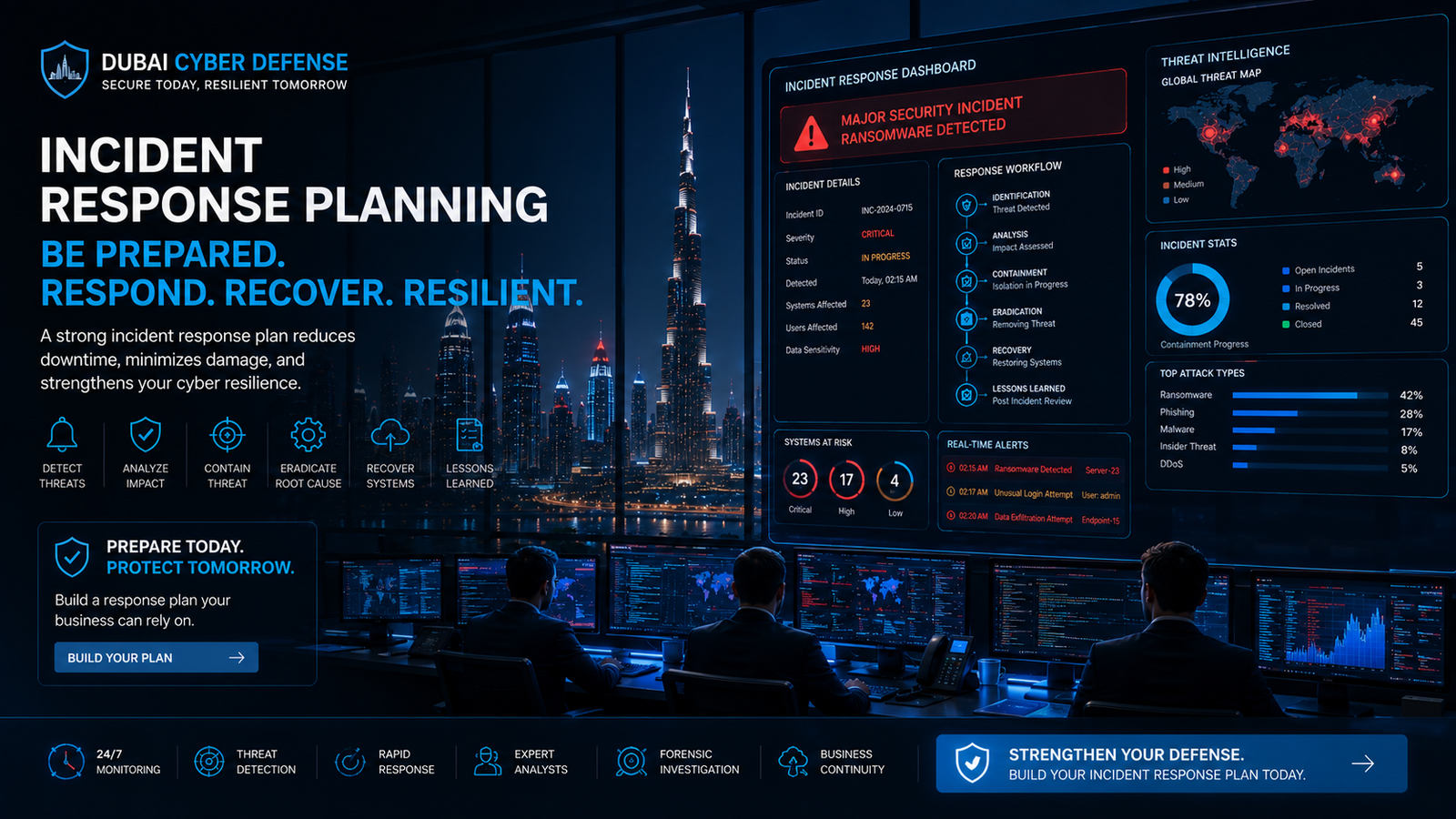
Introduction
Cyber attacks are no longer a question of if. For businesses in Dubai and across the UAE, the real question is when.
Ransomware, phishing attacks, data breaches, insider threats, and cloud security incidents are becoming increasingly common. Even businesses with strong cyber security controls can experience incidents.
That is why preparation matters.
The difference between a minor security incident and a major business crisis often comes down to one factor: response readiness.
When an incident occurs, confusion becomes expensive.
Teams scramble to understand what happened, who should respond, what systems are affected, and how to contain the threat. Delays increase damage, downtime, financial loss, and reputational impact.
An incident response plan solves this problem.
It gives businesses a clear, structured process for detecting, containing, responding to, and recovering from cyber incidents.
The goal is simple.
Respond faster, reduce damage, and recover with confidence.
The Problem: Most Businesses Are Unprepared for Real Incidents
Many businesses invest in prevention but neglect response planning.
This creates a major gap.
Security tools may detect suspicious activity, but without a clear response process, teams often react slowly and inconsistently. Critical decisions get delayed. Communication breaks down.
Damage spreads.
This is especially dangerous during fast-moving incidents like ransomware or account compromise.
Minutes matter.
The biggest issue is uncertainty.
Who owns the incident? Who communicates with leadership? Who handles containment? When should customers or regulators be notified?
Without clear answers, response becomes chaotic.
For businesses in Dubai, this risk is growing as digital infrastructure becomes more complex and cyber threats continue to evolve.
Preparation can dramatically reduce incident impact.
The Solution: Build a Structured Incident Response Plan
An effective incident response plan provides a clear framework for handling cyber incidents from detection through recovery.
The first step is defining roles and responsibilities.
Every incident response plan should identify who leads the response, who manages technical containment, who communicates internally, and who handles external communication.
The second step is defining response phases.
A strong incident response plan typically includes preparation, detection, containment, eradication, recovery, and post-incident review.
Each phase should have clear actions.
This is where cyber security Dubai strategies such as monitoring, endpoint protection, and SOC as a service UAE become extremely valuable. Strong visibility improves early detection and enables faster response.
The plan should also include escalation paths, communication templates, contact lists, and recovery priorities.
The strongest incident response plans are practical, tested, and regularly updated.
A plan only works if teams know how to execute it.
Real Numbers: Prepared vs Unprepared Response
Approach | Typical Annual Cost | Business Impact
No incident response plan | AED 0 upfront | High disruption and slow recovery
Basic incident response planning | AED 15,000–40,000 | Faster response with reduced impact
Advanced incident response program | AED 40,000–120,000 | Strong resilience and rapid recovery
The difference is significant.
Businesses with tested incident response plans detect incidents faster, reduce downtime, and recover more efficiently.
The cost of preparation is small compared to the cost of prolonged disruption.
Fast response reduces damage.
UAE-Specific Security Considerations
For businesses operating in Dubai and across the UAE, incident response planning is critical for both operational resilience and compliance.
Security incidents involving sensitive customer data may trigger obligations under PDPL compliance UAE and broader data protection UAE requirements.
This makes response planning essential not only for security but also for regulatory readiness.
Key incident response priorities include:
● Threat detection and escalation
● Fast containment
● Communication planning
● Recovery procedures
● Compliance and breach notification readiness
Businesses that prepare for incidents reduce both business and compliance risk.
Response speed matters.
Why FortyFi
FortyFi helps businesses across Dubai and the UAE build practical incident response capabilities designed for modern cyber threats.
From incident response planning and tabletop exercises to threat detection and active monitoring, the focus is on improving readiness and reducing disruption.
The team helps businesses strengthen resilience, improve response speed, and recover faster from cyber incidents.
The objective is simple: prepare before an incident becomes a crisis.
FAQ
What is an incident response plan?
An incident response plan is a structured process for detecting, managing, and recovering from cyber security incidents.
Why is incident response important?
It reduces damage, minimizes downtime, and improves recovery during security incidents.
Which incidents should businesses prepare for?
Common incidents include ransomware, phishing, data breaches, insider threats, and cloud security incidents.
How often should plans be updated?
Incident response plans should be reviewed and updated regularly, especially after major infrastructure changes.
Does incident response planning help compliance?
Yes. It improves breach readiness and supports regulatory obligations.
Would Your Business Know What to Do During a Cyber Attack?
Cyber incidents move fast.
Businesses that respond slowly face greater damage, higher costs, and longer recovery times.
Preparation creates resilience.
The businesses that recover fastest are usually the ones that prepared first.
Message FortyFi today for an incident response readiness assessment and strengthen your business before the next incident occurs.