Cybersecurity
How to Conduct a Cybersecurity Risk Assessment for Your UAE SME
Jul 01, 2026
Introduction
Most cyber attacks do not start with advanced hacking.
They start with overlooked weaknesses.
A misconfigured cloud setting.
An unpatched device.
Weak passwords.
Excessive permissions.
Poor backups.
These small issues often create major security exposure.
That is why cyber security begins with visibility.
Before businesses can reduce risk, they need to understand where risk actually exists.
This is where cybersecurity risk assessments matter.
For SMEs across Dubai and the UAE, a risk assessment is one of the highest-value security
activities.
It provides clarity.
What systems are exposed?
Where are the biggest vulnerabilities?
Which threats matter most?
What should be fixed first?
Without these answers, businesses often spend money in the wrong places.
The question is no longer whether your business has cyber risk.
The real question is whether you understand it clearly enough to manage it.
The Problem: Most SMEs Underestimate Their Real Risk
Many SMEs assume they are too small to be targeted.
That is dangerous.
Attackers often target SMEs because defenses are weaker.
Resources are limited.
Security maturity is lower.
This creates opportunity for attackers.
Common SME cyber risks include:
● Phishing attacks
● Weak access controls
● Unpatched systems
● Cloud misconfigurations
● Poor backup readiness
The biggest challenge is visibility.
Many businesses do not know where their highest risks are.
Security gaps remain hidden.
Critical vulnerabilities go unnoticed.
Attackers exploit these blind spots.
Without structured assessment, businesses struggle to prioritize security investments effectively.
That increases exposure.
Risk becomes harder to manage.
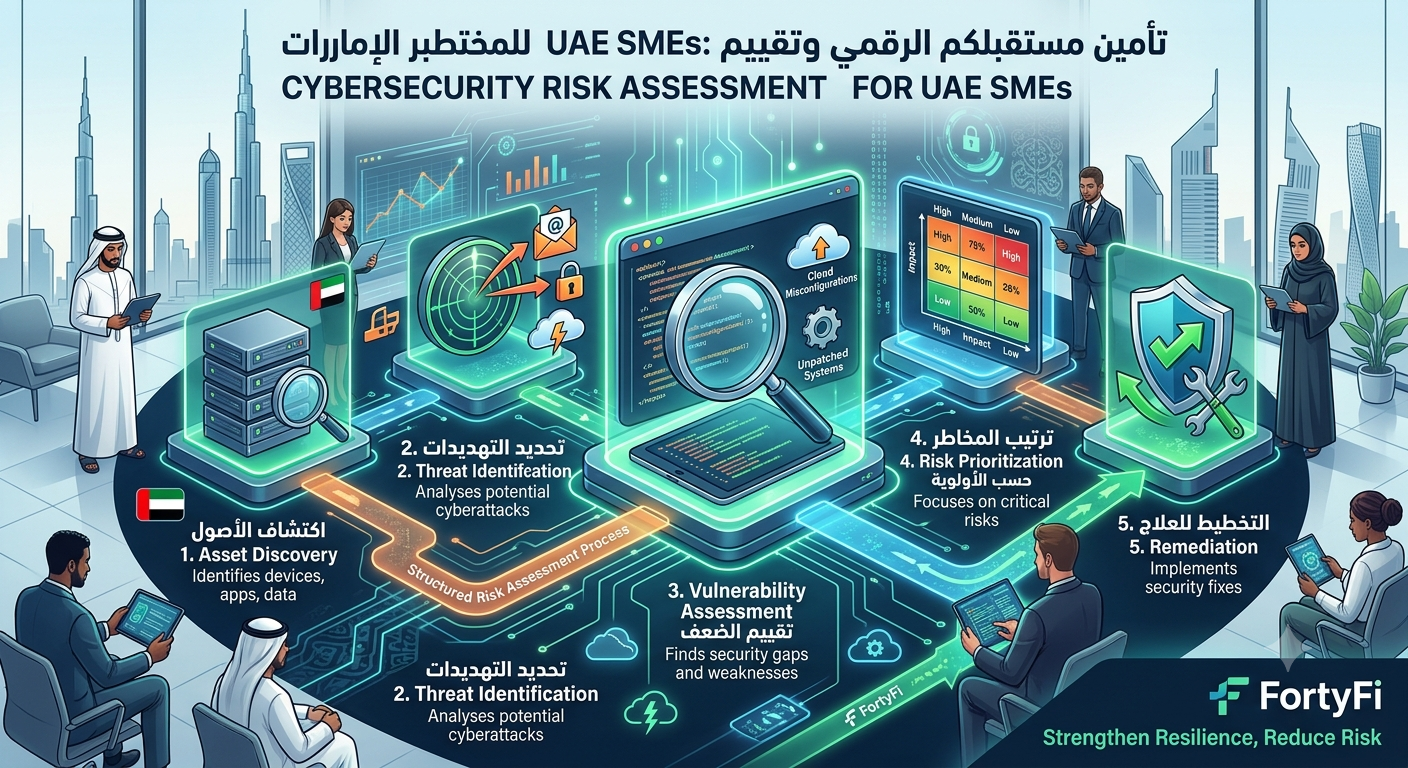
The Solution: Use a Structured Risk Assessment Process
Strong risk assessments focus on identifying, prioritizing, and reducing cyber exposure.
The first step is asset discovery.
Businesses must identify critical systems, applications, users, and data.
The second step is threat identification.
Understand which threats are most relevant to the business.
The third step is vulnerability assessment.
Identify weaknesses that attackers could exploit.
This is where cyber security Dubai, penetration testing cost Dubai, and SOC as a service
UAE become highly valuable. Strong assessments combine technical visibility with real threat
intelligence.
The fourth step is risk prioritization.
Not every issue carries equal risk.
Businesses should focus first on vulnerabilities with the highest business impact.
Key risk assessment priorities include:
● Asset visibility
● Threat analysis
● Vulnerability assessment
● Risk prioritization
● Remediation planning
The strongest businesses assess risk continuously.
Visibility improves decision-making.
Real Numbers: Risk Assessment Cost vs Breach Risk
Approach Typical Annual
Cost
Business Impact
Minimal risk assessment AED 0–10,000 High exposure risk
Basic risk assessment program AED
15,000–60,00
0
Improved visibility
Advanced security assessment
strategy
AED
60,000–200,0
00+
Strong resilience and risk
reduction
The numbers are clear.
The cost of a strong risk assessment is significantly lower than the financial damage caused by
a major breach.
Better visibility reduces risk.
Smarter investments improve protection.
UAE-Specific Security Considerations
For businesses operating in Dubai and across the UAE, risk assessments directly affect
resilience and compliance.
Security weaknesses involving sensitive data can impact PDPL compliance UAE and broader
data protection UAE obligations.
Key risk assessment priorities include:
● Data protection
● Threat visibility
● Access control
● Risk reduction
● Compliance readiness
Businesses handling sensitive systems should treat risk assessment as a strategic priority.
Visibility drives resilience.
Why FortyFi
FortyFi helps SMEs across Dubai and the UAE strengthen cyber resilience through practical risk
assessments and security strategies.
From asset reviews and vulnerability assessments to monitoring and threat response, the focus
is on identifying risk before incidents occur.
The team helps businesses improve visibility, prioritize security investments, and reduce cyber
exposure.
The objective is simple: understand risk clearly and reduce it strategically.
FAQ
What is a cybersecurity risk assessment?
It is a structured process for identifying and prioritizing cyber risks.
Why is risk assessment important?
It helps businesses understand vulnerabilities and prioritize security investments.
How often should SMEs conduct risk assessments?
At least annually or after major infrastructure changes.
Is penetration testing part of risk assessment?
Yes. It can help validate exploitable weaknesses.
Does risk assessment help compliance?
Yes. It improves resilience and compliance readiness.
Do You Know Where Your Biggest Cyber Risks Are?
Most businesses have security gaps.
The problem is many do not know where.
Businesses that assess risk proactively reduce exposure dramatically.
Message FortyFi today for a cybersecurity risk assessment and strengthen your business before
threats become incidents.