Cybersecurity
How to Integrate AI Into Your Existing UAE Software Without a Rebuild
Jul 01, 2026
Introduction
Most UAE companies already have software systems in place.
CRMs.
ERPs.
Custom internal platforms.
Customer portals.
Legacy databases.
These systems often represent years of investment.
And replacing them is expensive, slow, and risky.
So when businesses decide to adopt AI, they often assume a full rebuild is required.
That assumption is wrong.
In most cases, AI does not require replacing your existing systems.
It requires extending them.
Modern AI can integrate into existing software layers without disrupting core infrastructure.
This is especially important for businesses in Dubai and across the UAE, where operational
continuity and compliance are critical.
The question is no longer whether AI requires a rebuild.
The real question is how to integrate AI into existing systems safely and efficiently.
The Problem: Businesses Think AI Requires Full System Replacement
A common misconception is that AI adoption means starting from scratch.
This leads to hesitation.
Or delayed adoption.
Or overinvestment in unnecessary rebuilds.
Typical concerns include:
● “Our system is too old for AI”
● “We need a new platform first”
● “Integration will break everything”
● “AI only works with modern systems”
These assumptions are outdated.
Modern AI systems are designed for integration.
Not replacement.
The biggest challenge is not technical incompatibility.
It is architectural misunderstanding.
Businesses often underestimate how flexible AI integration layers have become.
This results in missed opportunities.
And unnecessary costs.
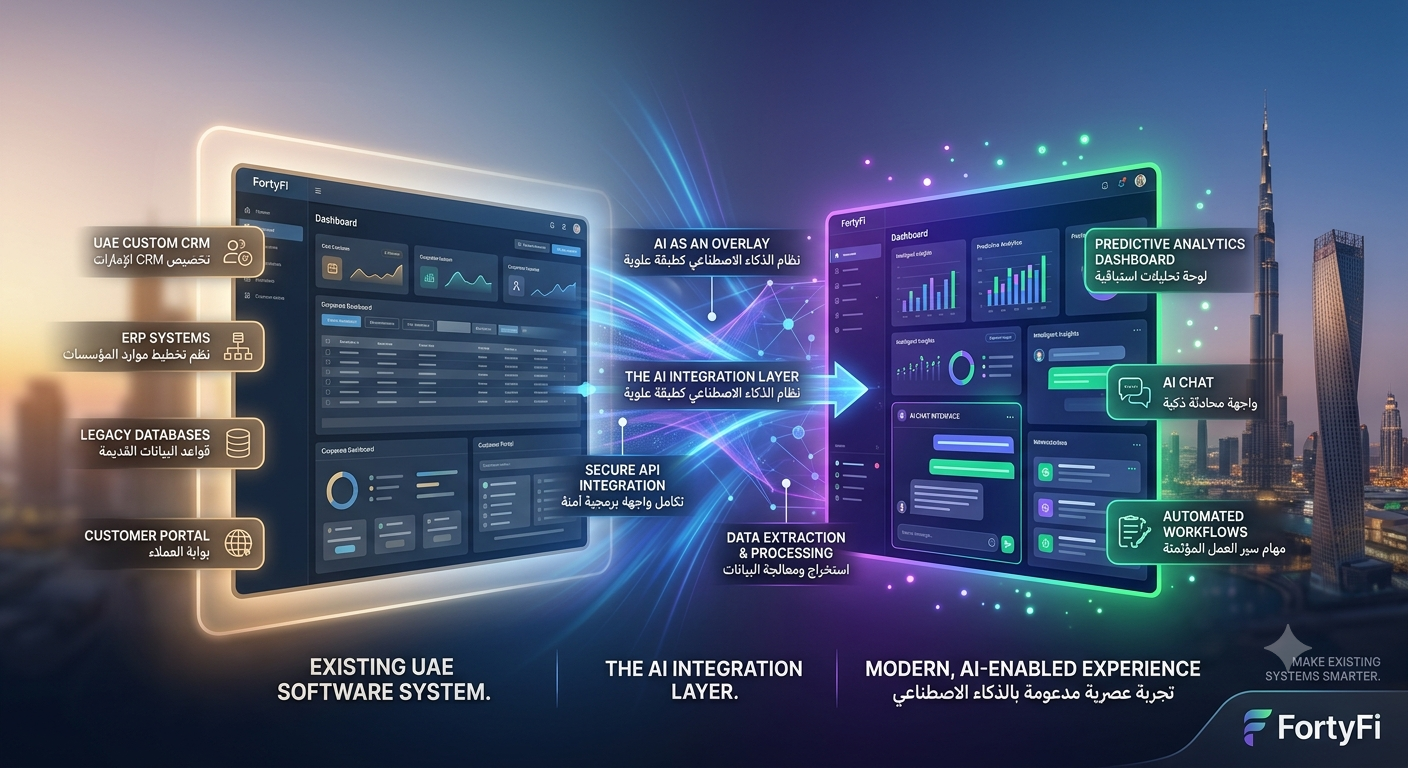
The Solution: AI as an Overlay Layer on Existing Systems
AI can be integrated as a layer on top of existing software.
Not inside it.
This approach preserves current systems while adding intelligence.
The first layer is API integration.
AI connects to existing systems through secure APIs.
The second layer is data extraction.
Relevant data is pulled from existing databases and systems.
The third layer is AI processing.
LLMs and machine learning models analyze and generate insights.
The fourth layer is action execution.
AI sends outputs back into the system.
This is where AI development Dubai, LLM implementation GCC, and AI consulting Dubai
become highly valuable. Proper integration strategies allow businesses to modernize without
disruption.
Common AI integration patterns include:
● CRM AI enhancement
● ERP automation layers
● AI chat interfaces for legacy systems
● Document processing overlays
● Workflow automation tools
Key business benefits include:
● No system replacement required
● Faster deployment timelines
● Lower implementation risk
● Improved operational efficiency
● Scalable AI adoption
The strongest AI strategies enhance existing systems instead of replacing them.
Real Numbers: Rebuild vs AI Integration Approach
Approach Typical
Investment
Business Impact
Full system
rebuild
AED
1M–
10M
+
High risk, long
timelines
Partial system
modernization
AED
300,
000–
2M
Moderate disruption
AI overlay
integration
AED
150,
000–
1.5M
Fast deployment,
low disruption
The numbers are clear.
Rebuilding systems is expensive and slow.
AI integration is faster and more cost-effective.
Most UAE businesses benefit more from augmentation than replacement.
UAE-Specific Business Considerations
For companies in Dubai and across the UAE, system stability and compliance are critical.
Many organizations operate legacy systems that cannot be easily replaced.
This is where agentic AI UAE and machine learning UAE become essential for bridging old
and new systems.
Industries benefiting from AI integration include:
● Banking
● Government services
● Logistics
● Healthcare
● Real estate
Key AI priorities include:
● System stability
● Data security
● Compliance
● Scalability
● Operational continuity
Businesses should treat AI integration as a modernization layer.
Not a system replacement strategy.
Common Pitfalls in AI Integration
Despite its simplicity, AI integration can fail if poorly designed.
Common pitfalls include:
1. Poor API Design
Weak APIs limit AI access to system data.
2. Lack of Data Standardization
Inconsistent data reduces AI accuracy.
3. Overcomplicated Architecture
Too many integration layers increase failure risk.
4. No Security Controls
Poor access management creates vulnerabilities.
5. Ignoring System Latency
Real-time performance must be considered.
The solution is clean architecture and modular integration design.
Why FortyFi
FortyFi helps businesses across Dubai and the UAE integrate AI into existing software systems
without costly rebuilds.
From API design and AI overlay architecture to workflow automation and system modernization,
the focus is on low-risk, high-impact AI adoption.
The team helps organizations unlock AI value quickly while preserving existing infrastructure
investments.
The objective is simple: make existing systems smarter without rebuilding them.
FAQ
Do I need to rebuild my software to use AI?
No. Most systems can integrate AI through APIs and overlays.
What is an AI overlay?
A layer that adds AI capabilities on top of existing systems.
Is integration risky?
Not if properly designed with secure architecture.
How fast can AI be integrated?
Many systems can be enhanced in weeks, not months.
What systems can be upgraded?
CRMs, ERPs, portals, and most enterprise software.
Can Your Existing Software Become AI-Enabled?
You don't need to rebuild everything.
You need to upgrade intelligently.
Message FortyFi today for an AI integration assessment and modernize your systems without
disruption.