Cloud & Infrastructure
How UAE Banks Architect for Regulatory-Grade Resilience
Jul 01, 2026
Introduction
UAE banks don't build for uptime—they build for regulatory-grade resilience. With CBUAE demanding uninterrupted critical services and DFSA proposing new operational resilience regimes, resilience is now an architectural requirement, not just an IT objective.
The Problem: Operational Resilience Is a Regulatory Mandate
The CBUAE requires banks to establish operational risk governance, define risk tolerance, manage disruptions, and conduct scenario analysis . The DFSA's proposed framework would require firms to identify critical business services and set impact tolerances for maximum acceptable disruption . Under CBUAE rules, failure to maintain resilience has real consequences .
The Solution: An Architecture Based on the Five Pillars
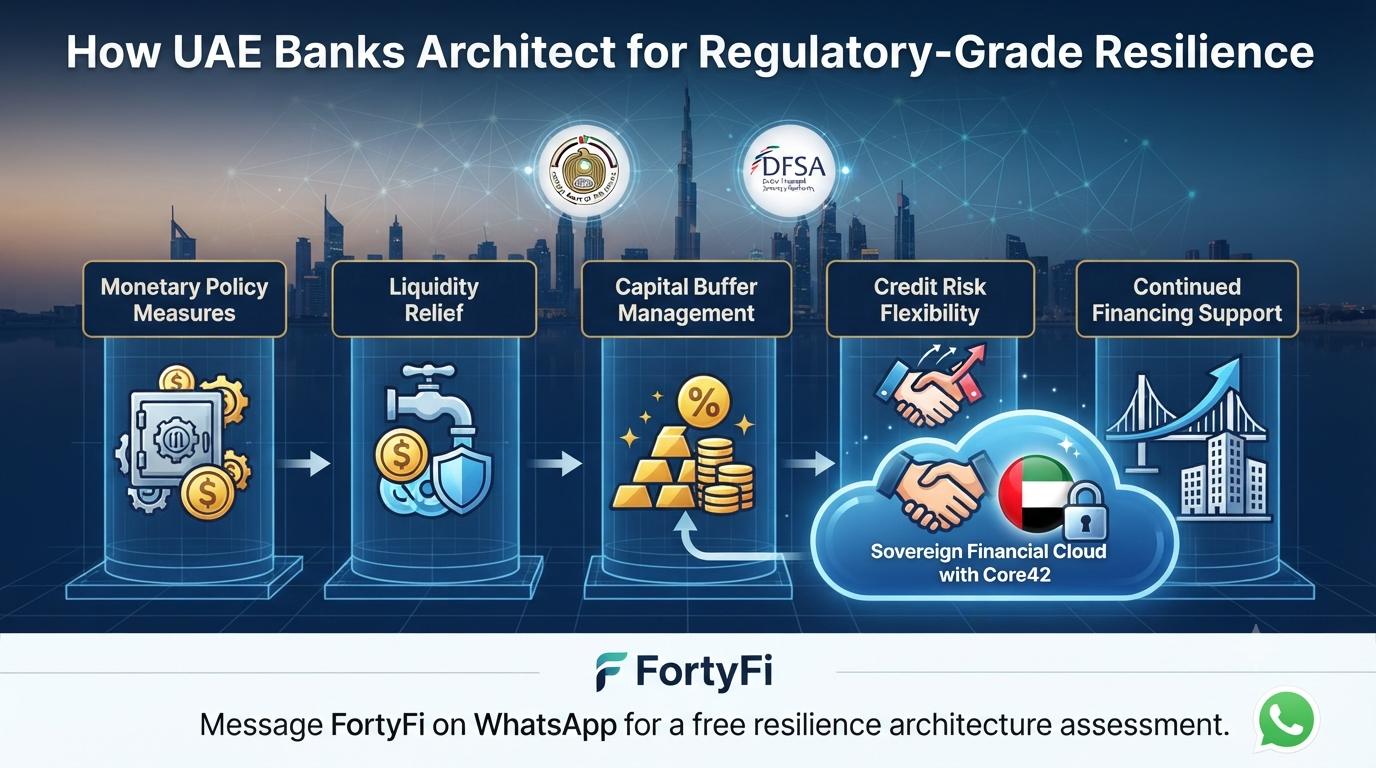
Banks architect resilience according to CBUAE's five-pillar framework: monetary policy measures; liquidity relief; capital buffer management; credit risk flexibility; and continued financing support . The sovereign financial cloud with Core42 embeds governance, oversight, and AI capabilities directly into financial infrastructure, ensuring data sovereignty and cyber resilience .
Real Numbers: The Regulatory Impact
Why FortyFi
FortyFi helps UAE banks design resilience architectures aligned with CBUAE and DFSA frameworks—from sovereign cloud adoption to operational resilience testing.
FAQ
What is regulatory-grade resilience? An architecture designed to meet CBUAE and DFSA resilience requirements, not just internal uptime goals. How does sovereign financial cloud help? It embeds regulatory oversight directly into the infrastructure, ensuring data sovereignty and operational agility . What's the DFSA proposing? A framework requiring firms to set impact tolerances and test resilience through severe scenarios .
Architect for Resilience
Message FortyFi on WhatsApp for a free resilience architecture assessment.