Cybersecurity
Mobile Device Management for UAE Companies With BYOD Policies
Jul 01, 2026
Introduction
Bring Your Own Device (BYOD) is now common across businesses in Dubai and the UAE.
Employees use personal smartphones, tablets, and laptops to access company systems every
day.
Email.
Cloud platforms.
CRMs.
Messaging apps.
Internal dashboards.
Customer data.
This improves flexibility and productivity.
It also creates major security challenges.
Every personal device connected to business systems expands the attack surface. Unlike
corporate-managed devices, personal devices often have inconsistent security settings, limited
monitoring, and mixed personal-business usage.
That creates significant risk.
A lost device, compromised phone, insecure app, or outdated operating system can quickly
become a business security incident.
The question is no longer whether BYOD is here to stay.
The real question is whether your business can secure it effectively.
The Problem: BYOD Creates Hidden Security Gaps
BYOD increases convenience.
But convenience often comes with weaker control.
That creates dangerous exposure.
When employees use personal devices for business access, security teams lose visibility and
control over endpoints interacting with critical systems.
Common BYOD risks include:
● Lost or stolen devices
● Weak device passwords
● Unsecured applications
● Malware infections
● Data leakage
Visibility becomes the biggest challenge.
Many businesses cannot accurately track which devices access corporate resources, what
security posture those devices have, or whether they meet security standards.
This creates major blind spots.
A single compromised device can expose sensitive data, business systems, and internal
applications.
Attackers increasingly target mobile devices because they often have weaker controls than
traditional endpoints.
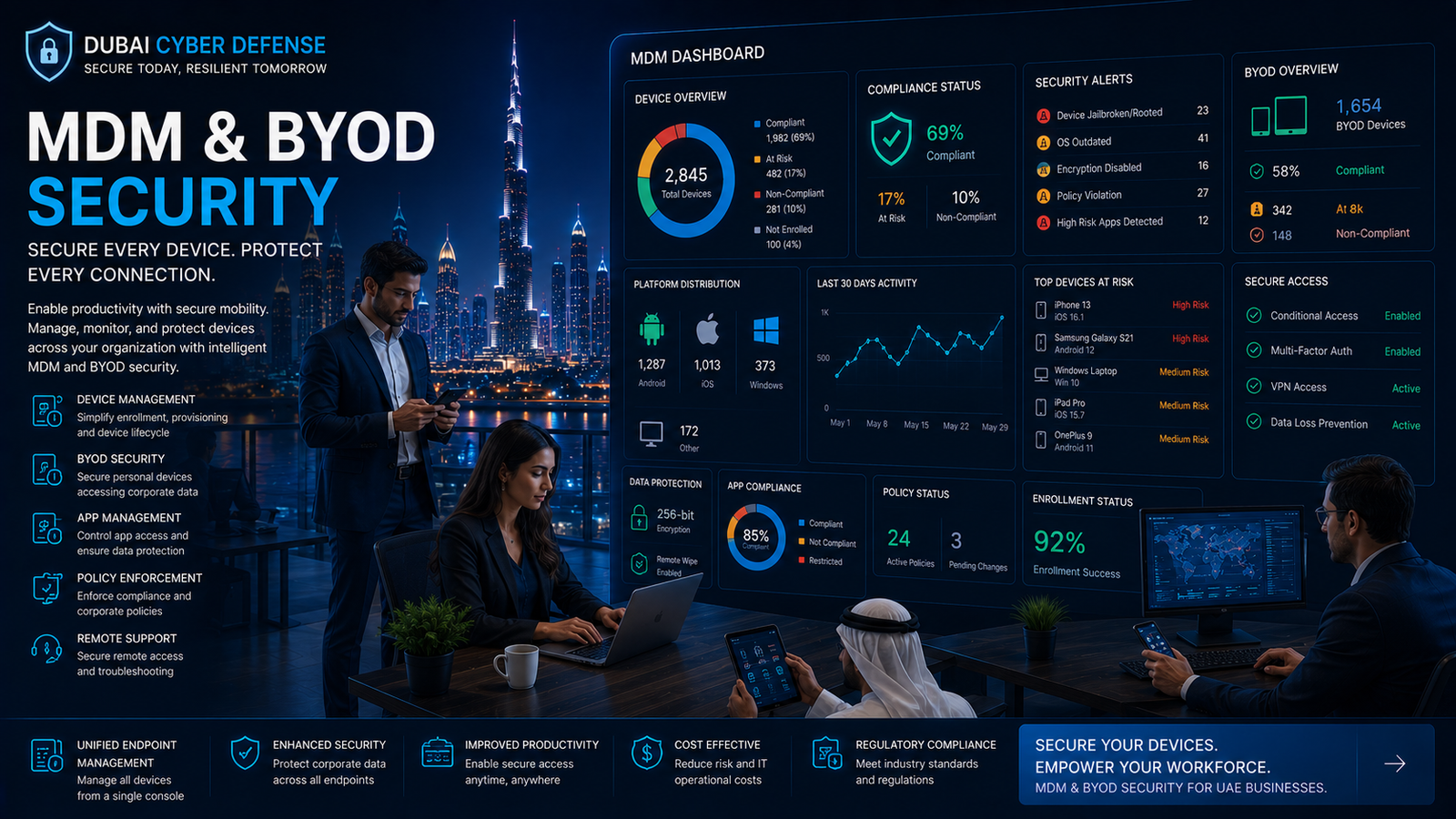
The Solution: Secure BYOD with Mobile Device Management
The strongest BYOD security strategy starts with control and visibility.
This is where Mobile Device Management (MDM) becomes essential.
MDM helps businesses enforce security policies across employee devices without
compromising usability.
The first layer is device enrollment.
Every device accessing business systems should be identified and managed.
The second layer is policy enforcement.
Businesses should require device encryption, screen locks, secure passwords, and approved
app usage.
The third layer is access control.
Only compliant devices should access sensitive systems.
This is where cyber security Dubai strategies and SOC as a service UAE provide strong
value. Continuous monitoring improves device visibility and helps identify suspicious activity
faster.
The fourth layer is response readiness.
Remote wipe, device lock, and rapid incident response reduce risk if a device is lost or
compromised.
The strongest MDM strategies balance security and employee productivity.
Control creates resilience.
Real Numbers: MDM Cost vs BYOD Risk
Approach Typical Annual
Cost
Business Impact
Minimal BYOD controls AED 0–10,000 High device-related risk
Basic MDM program AED
20,000–60,00
0
Reduced mobile risk
Advanced enterprise mobility
program
AED
60,000–180,0
00
Strong visibility and
control
The cost comparison is clear.
The investment required for strong BYOD security is significantly lower than the financial and
operational damage caused by data leakage or device compromise.
Mobile security reduces business risk.
Visibility improves control.
UAE-Specific Security Considerations
For businesses operating in Dubai and across the UAE, mobile security directly affects both
cyber resilience and compliance.
Sensitive business or customer data exposed through mobile devices can impact PDPL
compliance UAE and broader data protection UAE obligations.
Key BYOD security priorities include:
● Device visibility
● Access control
● Policy enforcement
● Monitoring
● Incident response readiness
Businesses allowing employee devices to access business systems should treat mobile security
as a strategic priority.
Unmanaged devices create hidden exposure.
Why FortyFi
FortyFi helps businesses across Dubai and the UAE secure BYOD environments through
practical mobile security and cyber resilience strategies.
From MDM implementation and policy design to monitoring and threat response, the focus is on
reducing mobile-related risk without disrupting productivity.
The team helps businesses improve visibility, strengthen controls, and secure employee device
access.
The objective is simple: protect business systems in a mobile-first workplace.
FAQ
What is BYOD?
BYOD stands for Bring Your Own Device, where employees use personal devices for work
access.
Why is BYOD risky?
Personal devices often have weaker security controls and limited monitoring.
What is MDM?
Mobile Device Management helps businesses manage and secure employee devices.
Can MDM protect personal devices?
Yes. It helps enforce business security policies on devices accessing company systems.
Does MDM help compliance?
Yes. Strong mobile security reduces breach risk and improves compliance readiness.
Are Personal Devices Quietly Increasing Your Security Risk?
BYOD improves flexibility.
But unmanaged devices create major security gaps.
Businesses that improve device visibility and control dramatically reduce exposure.
Message FortyFi today for a mobile security assessment and strengthen your BYOD security
strategy.