AI & Agentic AI
Multi-Agent Systems: When Your UAE Business Needs More Than One AI
Jul 01, 2026
Introduction
Most businesses think of AI as a single system.
One chatbot.
One assistant.
One model answering questions.
But as AI adoption matures across Dubai and the UAE, this assumption starts to break down.
Because real business processes are not simple.
They are multi-step.
Multi-system.
Multi-department.
And often require coordination between different types of intelligence.
This is where multi-agent systems become important.
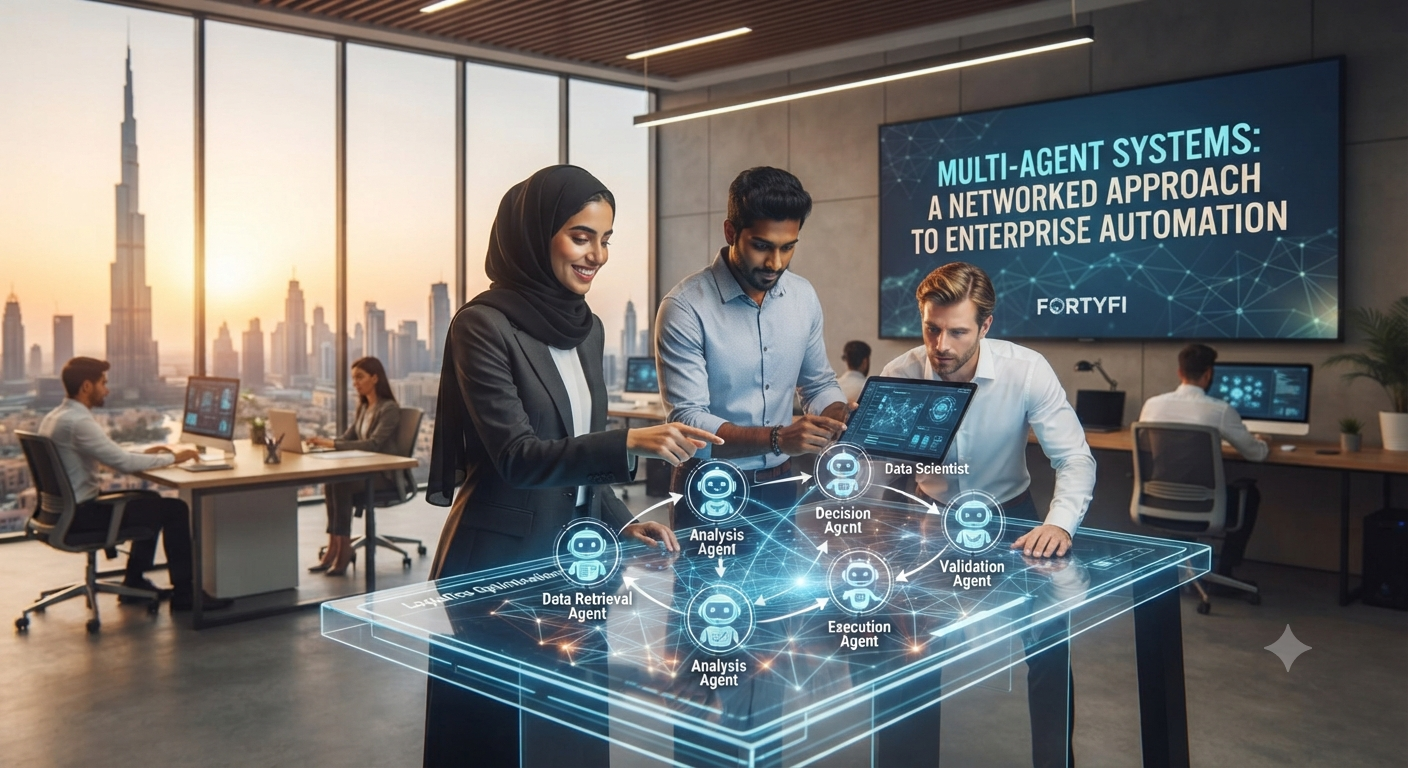
A multi-agent system is not one AI.
It is a network of AI agents working together.
Each agent has a role.
A responsibility.
A specialization.
One agent may handle data retrieval.
Another may analyze information.
Another may make decisions.
Another may execute actions.
Instead of one AI trying to do everything, multiple AIs collaborate like a team.
The question is no longer whether AI can automate tasks.
The real question is when a single AI is no longer enough.
And when your business needs multiple AI agents working together.
The Problem: Single AI Systems Break Down in Complex Workflows
Single AI systems work well for simple tasks.
But modern business workflows are not simple.
Common limitations of single-agent AI include:
● Lack of specialization
● Limited context handling
● Weak multi-step reasoning
● Poor tool orchestration
● Difficulty managing complex workflows
The biggest challenge is complexity.
For example, consider a customer refund process:
One AI must:
● Verify customer identity
● Check transaction history
● Validate refund eligibility
● Apply policy rules
● Trigger payment systems
● Log compliance records
A single AI trying to handle all steps often becomes unreliable.
Errors increase.
Logic breaks.
Performance becomes inconsistent.
As workflows grow, single-agent systems struggle to scale effectively.
Businesses need structured coordination between multiple AI systems.
The Solution: Multi-Agent AI Systems for Complex Business Processes
Multi-agent systems divide intelligence into specialized roles.
Each agent focuses on a specific function.
Together, they complete end-to-end workflows.
The first layer is task decomposition.
Complex workflows are broken into smaller tasks.
The second layer is agent specialization.
Each AI agent is assigned a specific role.
The third layer is orchestration.
A coordinator agent manages communication between agents.
This is where AI development Dubai, agentic AI UAE, and AI consulting Dubai become
highly valuable. Multi-agent architecture enables scalable enterprise automation.
Common multi-agent roles include:
● Data retrieval agent
● Analysis agent
● Decision agent
● Execution agent
● Validation agent
Key business benefits include:
● Higher accuracy
● Better scalability
● Improved workflow automation
● Reduced system failure
● Stronger modularity
The strongest AI systems are not single models.
They are coordinated systems of intelligent agents.
Real Numbers: Single-Agent vs Multi-Agent Systems
Approach Typical
Investment
Business Impact
Single AI assistant AED
50,000–
200,000
Limited workflow
automation
Basic multi-agent
setup
AED
200,000
–900,000
Strong process
automation
Enterprise multi-agent
architecture
AED
900,000
–6M+
Full-scale intelligent
operations
The numbers are clear.
Single agents work for simple tasks.
Multi-agent systems unlock enterprise-level automation.
But require more advanced architecture.
UAE-Specific Business Considerations
For businesses operating in Dubai and across the UAE, automation complexity is increasing
rapidly.
This is where machine learning UAE and LLM implementation GCC become critical for
building scalable enterprise AI systems.
Industries benefiting from multi-agent systems include:
● Banking
● Logistics
● Government services
● Healthcare
● Enterprise operations
Key AI priorities include:
● Workflow automation
● Reliability
● Scalability
● Governance
● Integration
Businesses should treat multi-agent systems as a core enterprise architecture decision.
Not just an advanced AI feature.
Why FortyFi
FortyFi helps businesses across Dubai and the UAE design and deploy multi-agent AI systems
for real-world enterprise workflows.
From architecture design and agent orchestration to integration and optimization, the focus is on
building scalable AI systems that solve complex business problems.
The team helps organizations move beyond single AI tools into coordinated AI ecosystems.
The objective is simple: build intelligent systems that work together, not in isolation.
FAQ
What is a multi-agent AI system?
It is a system where multiple AI agents collaborate to complete complex tasks.
When do businesses need multi-agent systems?
When workflows become too complex for a single AI model.
Are multi-agent systems better than single AI?
For complex processes, yes.
Do they cost more?
Yes, but they provide higher scalability and automation value.
Can they be used in enterprise automation?
Yes. They are ideal for enterprise-scale workflows.
Is One AI Enough for Your Business?
Simple tasks can be handled by a single model.
Complex operations cannot.
Businesses that adopt multi-agent systems gain stronger automation and scalability.
Message FortyFi today for an AI architecture assessment and design your multi-agent AI
strategy.