Cybersecurity
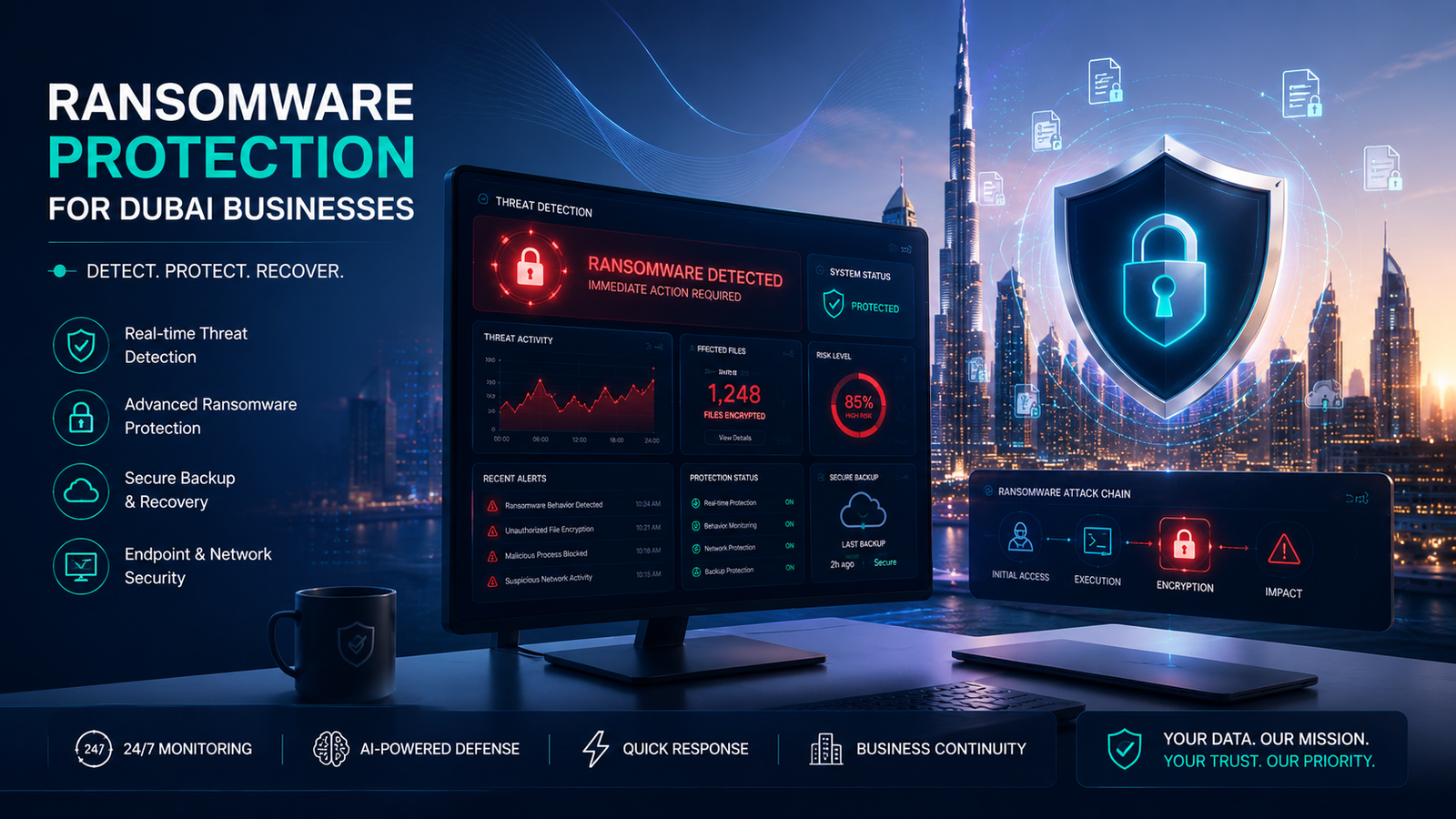
Ransomware Protection for Dubai Businesses: A 2026 Survival Guide
Jun 30, 2026
Introduction
Ransomware has become one of the most damaging cyber threats facing businesses in Dubai
and across the UAE. What was once considered a threat mainly targeting large enterprises has
evolved into a widespread business risk affecting organizations of every size.
Attackers are no longer just encrypting files.
Modern ransomware operations steal sensitive data, disrupt business operations, and threaten
public exposure if payment demands are not met. This makes the financial and reputational
damage far more severe than traditional cyber attacks.
For many businesses, ransomware is no longer a theoretical risk.
It is one of the most likely and costly security incidents they may face in 2026.
The real danger is not only the attack itself. It is how quickly ransomware can spread through
systems when businesses are unprepared.
The question is no longer whether ransomware is a major threat.
The real question is whether your business could survive one.
The Problem
Ransomware attacks move fast.
A single phishing email, compromised account, or unpatched vulnerability can give attackers
initial access. Once inside, they move laterally across systems, escalate privileges, disable
backups, and target critical business infrastructure.
The damage escalates rapidly.
Files become encrypted. Operations stop. Employees lose access to systems. Customers
experience service disruptions. Sensitive data may be stolen before encryption begins.
For many businesses, the biggest cost is not the ransom payment itself.
It is the downtime.
Operational disruption, recovery costs, legal exposure, customer communication, and
reputational damage often create losses far greater than the ransom demand.
Businesses with weak visibility typically detect ransomware too late.
By the time the incident becomes obvious, the damage is already widespread.
The Solution
Effective ransomware protection requires a layered defence strategy.
Prevention is the first layer.
Strong access controls, multi-factor authentication, endpoint protection, and regular patching
reduce the likelihood of initial compromise. Employee awareness training also helps prevent
phishing-based attacks.
Detection is the second layer.
Businesses need visibility into suspicious behavior before encryption begins. This is where SOC
as a service UAE becomes highly valuable. Continuous monitoring enables early detection of
ransomware indicators such as unusual privilege escalation, suspicious file activity, or abnormal
network behavior.
Recovery is the final layer.
Secure, isolated, and regularly tested backups are essential. Even the best security controls
cannot eliminate all risk. Businesses must be able to restore operations quickly if an incident
occurs.
The strongest defence combines prevention, rapid detection, and resilient recovery.
Real Numbers
The financial difference is significant.
A strong ransomware defence program costs far less than a major incident involving business
downtime, lost revenue, and recovery costs.
For many businesses, even a few days of downtime can exceed the cost of years of proactive
protection.
The economics strongly favor preparation.
UAE Specific Considerations
For businesses operating in Dubai and across the UAE, ransomware creates both operational
and compliance risk.
If sensitive customer or business data is exposed, organizations may face additional obligations
related to PDPL compliance UAE and broader data protection UAE requirements.
This makes ransomware not only a security concern but also a business continuity and
compliance challenge.
Key defence priorities include:
● Endpoint protection
● Secure backups and recovery planning
● Threat monitoring and detection
● Access control and identity security
● Incident response readiness
Businesses must prepare for ransomware before an incident occurs.
Reactive security is rarely enough.
Why FortyFi
FortyFi helps businesses across Dubai and the UAE strengthen ransomware resilience through
modern cyber security strategies built around prevention, detection, and rapid response.
From endpoint security and backup strategy to advanced monitoring and threat detection, the
focus is on reducing risk and improving recovery readiness.
The team helps businesses identify vulnerabilities, strengthen infrastructure, and build security
programs designed to withstand modern ransomware threats.
The objective is simple: stop ransomware before it becomes a business crisis.
FAQ
What is ransomware?
Ransomware is malware that encrypts files or systems and demands payment to restore
access.
How do ransomware attacks usually start?
Most attacks begin through phishing emails, compromised credentials, or unpatched
vulnerabilities.
Are backups enough for protection?
Backups are essential but should be part of a broader security strategy including prevention and
detection.
Can SMBs be targeted by ransomware?
Yes. SMBs are frequent targets because they often have weaker security controls.
Does ransomware affect compliance?
Yes. Data exposure during ransomware incidents can create regulatory and legal risks.
Could Your Business Survive a Ransomware Attack?
Ransomware is one of the fastest-growing threats in Dubai’s digital economy.
The cost of recovery continues to rise.
Businesses that prepare now will be far better positioned to prevent damage, recover faster, and
protect customer trust.
Message FortyFi today for a ransomware readiness assessment and strengthen your business
before attackers strike.