Cybersecurity
Secure Cloud Migration: Don't Carry Your Vulnerabilities to the Cloud
Jul 01, 2026
Introduction
Cloud migration is accelerating.
Across Dubai and the UAE, businesses are moving workloads to the cloud to improve
scalability, flexibility, performance, and operational efficiency.
The business case is clear.
Lower infrastructure overhead.
Faster deployment.
Better scalability.
Improved resilience.
Greater agility.
But there is a dangerous misconception.
Many businesses assume moving to the cloud automatically improves security.
It does not.
The cloud changes infrastructure.
It does not automatically remove vulnerabilities.
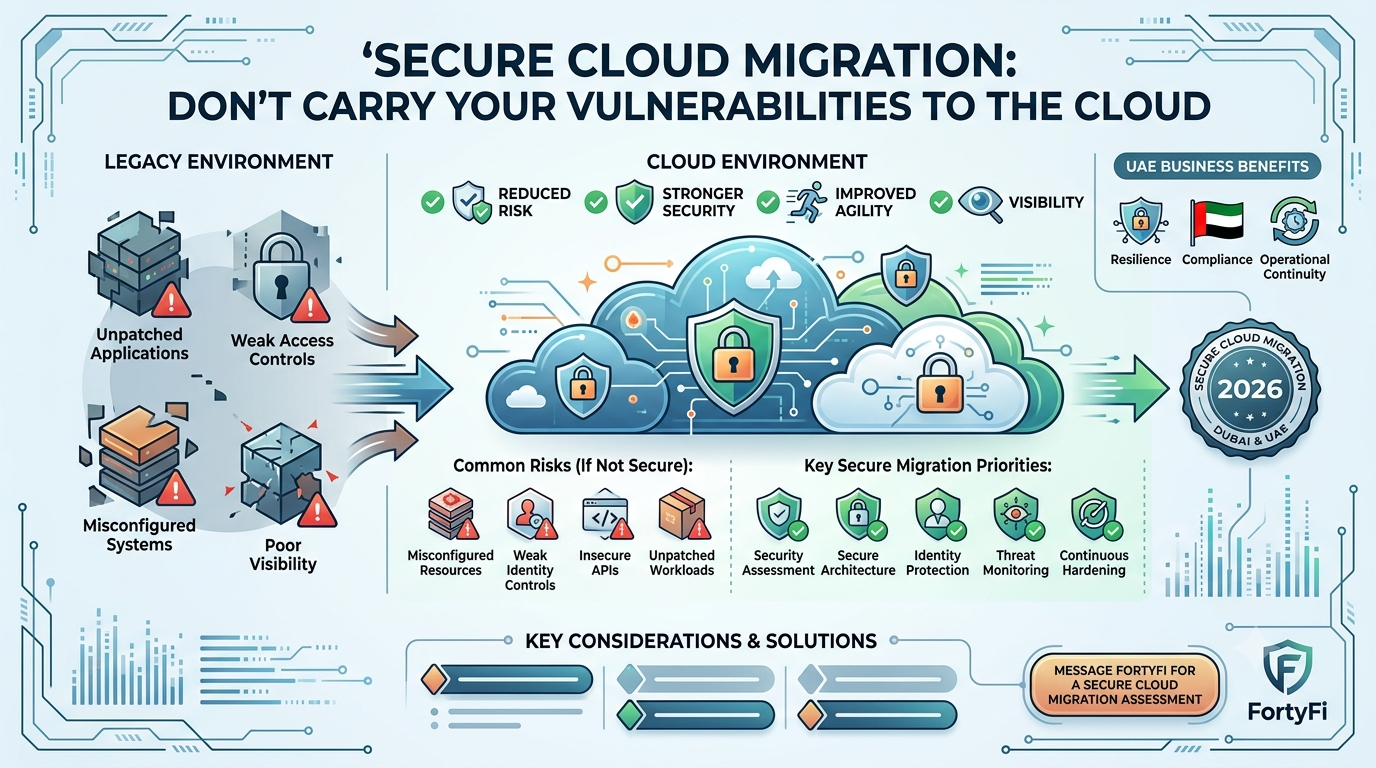
Weak access controls.
Misconfigured systems.
Unpatched applications.
Poor visibility.
Excessive permissions.
These problems do not disappear during migration.
In many cases, they simply move with you.
And sometimes they become harder to detect.
That creates major risk.
The question is no longer whether cloud migration delivers business value.
The real question is whether your migration is reducing risk or carrying vulnerabilities into a new
environment.
The Problem: Migration Without Security Creates Bigger Risks
Cloud adoption introduces new complexity.
That complexity creates risk.
Businesses often focus heavily on migration speed.
Security becomes secondary.
That creates dangerous exposure.
Common cloud migration security risks include:
● Misconfigured cloud resources
● Weak identity controls
● Insecure APIs
● Unpatched workloads
● Poor visibility
The biggest challenge is inherited risk.
Businesses often migrate legacy vulnerabilities into cloud environments.
Old security gaps remain.
New cloud-specific risks appear.
This creates expanded attack surfaces.
Attackers exploit these weaknesses.
A fast migration without security planning often increases exposure instead of reducing it.
Weak cloud migration strategy creates long-term cyber risk.
The Solution: Build Security Into Every Migration Phase
Secure cloud migration starts before workloads move.
The first layer is assessment.
Businesses must identify vulnerabilities, dependencies, and security gaps in current
environments.
The second layer is architecture.
Cloud environments should be designed with secure configurations and least-privilege access.
The third layer is visibility.
Security monitoring must cover cloud workloads, identities, and infrastructure.
This is where cyber security Dubai, SOC as a service UAE, and cloud security assessments
provide major value. Strong visibility helps businesses reduce cloud-related risk significantly.
The fourth layer is continuous hardening.
Cloud security requires ongoing monitoring, patching, and optimization.
Key secure migration priorities include:
● Security assessment
● Secure architecture
● Identity protection
● Threat monitoring
● Continuous hardening
The strongest cloud migrations improve security.
Migration should reduce risk, not transfer it.
Real Numbers: Secure Migration Cost vs Cloud Risk
Approach Typical Annual
Cost
Business Impact
Basic migration only AED 20,000–60,000 High inherited risk
Secure migration strategy AED
60,000–180,000
Reduced exposure
Advanced cloud security
program
AED
180,000–600,00
0+
Strong resilience and
visibility
The numbers are clear.
The cost of secure migration is significantly lower than the financial damage caused by cloud
security incidents.
Security improves migration value.
Preparation reduces risk.
UAE-Specific Security Considerations
For businesses operating in Dubai and across the UAE, cloud migration directly affects
resilience, compliance, and operational continuity.
Cloud environments handling sensitive data can impact PDPL compliance UAE and broader
data protection UAE obligations.
Key cloud migration priorities include:
● Data protection
● Access security
● Threat detection
● Cloud visibility
● Compliance readiness
Businesses moving critical workloads should treat secure migration as a strategic priority.
Weak migration creates major long-term risk.
Why FortyFi
FortyFi helps businesses across Dubai and the UAE strengthen cloud migration through
practical security-first strategies.
From security assessments and cloud architecture reviews to monitoring and hardening, the
focus is on reducing cloud-related cyber risk.
The team helps businesses improve visibility, strengthen controls, and migrate securely.
The objective is simple: ensure cloud migration improves both agility and security.
FAQ
Does cloud migration improve security automatically?
No. Vulnerabilities can still exist after migration.
What is the biggest cloud migration risk?
Moving legacy vulnerabilities into cloud environments.
Why are misconfigurations dangerous?
They create major cloud security exposure.
Should security start before migration?
Yes. Early assessment significantly reduces risk.
Does secure migration help compliance?
Yes. It improves resilience and compliance readiness.
Are You Moving to the Cloud Securely?
Cloud migration creates opportunity.
But insecure migration creates bigger risks.
Businesses that prioritize secure migration reduce cyber risk dramatically.
Message FortyFi today for a secure cloud migration assessment and strengthen your cloud
security strategy.