Cybersecurity
Securing AI Models and Training Data: A New Risk for UAE Companies
Jul 01, 2026
Introduction
AI is transforming business.
Across Dubai and the UAE, companies are rapidly adopting artificial intelligence to improve
efficiency, automate workflows, strengthen decision-making, and create competitive
advantages.
AI is everywhere.
Customer support.
Fraud detection.
Predictive analytics.
Automation.
Cybersecurity.
Business intelligence.
The opportunity is massive.
But AI introduces an entirely new category of cyber risk.
Most businesses focus on what AI can do.
Few focus enough on how AI systems can be attacked.
That creates dangerous exposure.
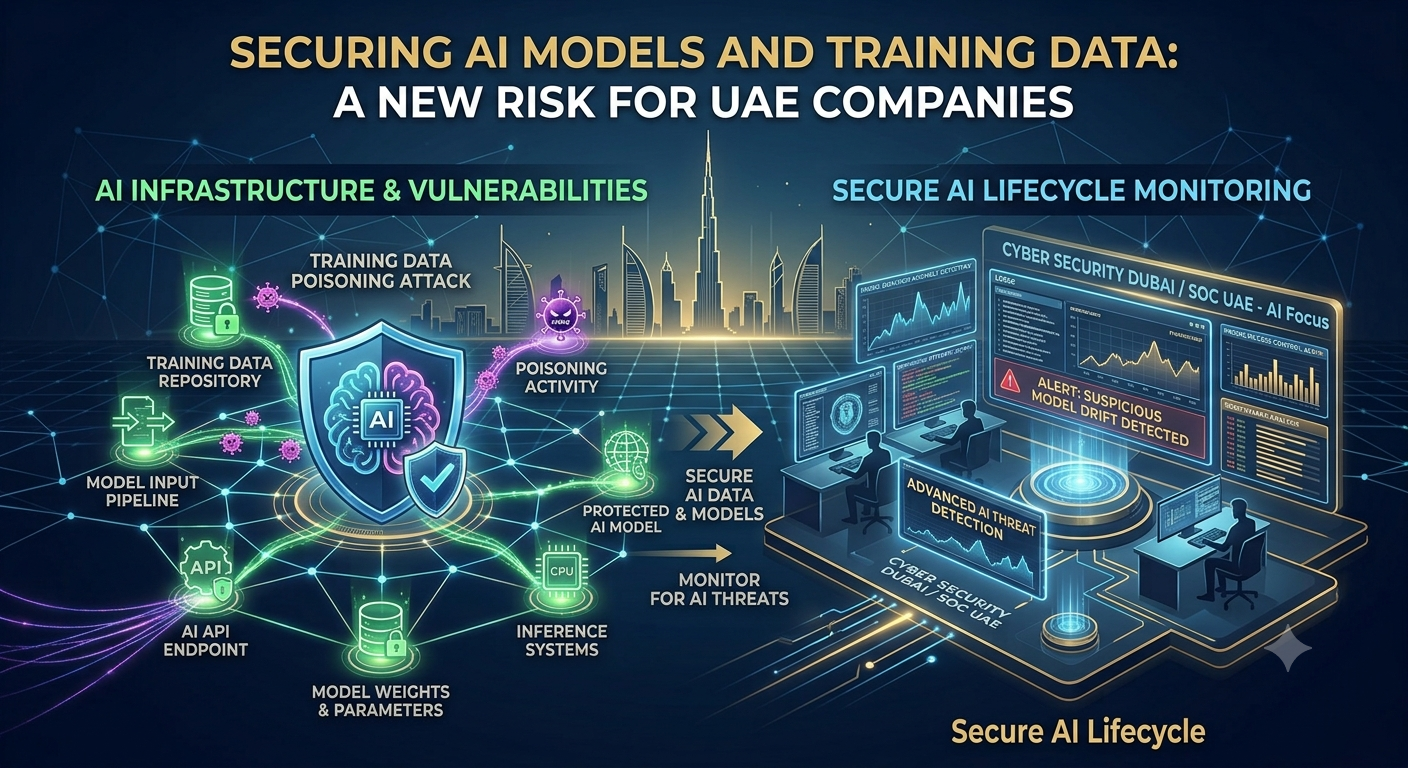
AI models depend on valuable assets.
Training data.
Model weights.
Pipelines.
APIs.
Inference systems.
Each layer creates risk.
Attackers are increasingly targeting AI systems because compromising AI can create enormous
business impact.
The question is no longer whether AI introduces security risk.
The real question is whether your AI systems are secure enough to protect business-critical
intelligence.
The Problem: AI Systems Create New Attack Surfaces
AI infrastructure is complex.
And complexity creates risk.
Traditional security controls alone are not enough.
AI introduces unique attack paths.
Common AI security risks include:
● Training data poisoning
● Model theft
● Prompt injection
● API abuse
● Sensitive data leakage
The biggest challenge is visibility.
Many businesses deploy AI quickly without fully understanding the security implications.
Models connect to cloud infrastructure.
Internal systems.
Third-party APIs.
Sensitive datasets.
This creates new attack surfaces.
Attackers exploit weak controls.
A poisoned dataset can corrupt model behavior.
A stolen model can expose proprietary intelligence.
A vulnerable AI API can leak sensitive information.
Weak AI security creates serious business exposure.
The Solution: Secure AI Across the Full Lifecycle
Strong AI security starts with data protection.
Training data must be protected from unauthorized access and manipulation.
The second layer is model security.
Models and inference pipelines should be secured against theft and abuse.
The third layer is access control.
Only authorized users and systems should interact with AI infrastructure.
This is where cyber security Dubai, SOC as a service UAE, and advanced security
monitoring become increasingly valuable. Strong visibility helps businesses detect AI-related
threats early.
The fourth layer is continuous monitoring.
Businesses should monitor AI systems for anomalies, abuse, and suspicious activity.
Key AI security priorities include:
● Data protection
● Model security
● Access control
● Threat monitoring
● Governance
The strongest businesses treat AI security as a strategic priority.
Security protects innovation.
Real Numbers: AI Security Cost vs Breach Risk
Approach Typical Annual
Cost
Business Impact
Minimal AI security AED 0–20,000 High AI risk
Basic AI security program AED
30,000–120,000
Reduced exposure
Advanced AI security
strategy
AED
120,000–500,00
0+
Strong resilience and
visibility
The numbers are clear.
The cost of strong AI security is significantly lower than the financial and operational damage
caused by compromised AI systems.
Protecting AI protects business value.
UAE-Specific Security Considerations
For businesses operating in Dubai and across the UAE, AI security directly affects resilience,
compliance, and business continuity.
AI systems handling sensitive data can impact PDPL compliance UAE and broader data
protection UAE obligations.
Key AI security priorities include:
● Data governance
● Access security
● Threat detection
● AI monitoring
● Compliance readiness
Businesses adopting AI should treat AI security as a strategic business requirement.
Weak AI security creates major long-term risk.
Why FortyFi
FortyFi helps businesses across Dubai and the UAE strengthen AI security through practical
cyber resilience strategies.
From AI security assessments and architecture reviews to monitoring and threat response, the
focus is on protecting AI systems before vulnerabilities become incidents.
The team helps businesses improve visibility, strengthen controls, and secure critical AI
infrastructure.
The objective is simple: secure AI innovation without increasing cyber risk.
FAQ
Why is AI security important?
AI systems introduce new attack surfaces and business risks.
What is training data poisoning?
It involves manipulating training data to influence model behavior.
Can AI models be stolen?
Yes. Weak controls can expose valuable models and intellectual property.
What is the biggest AI security risk?
Data leakage and weak access control are major risks.
Does AI security help compliance?
Yes. Strong AI governance improves resilience and compliance readiness.
Is AI Introducing Hidden Cyber Risks Into Your Business?
AI creates major opportunity.
It also creates new attack surfaces.
Businesses that secure AI early reduce risk dramatically.
Message FortyFi today for an AI security assessment and strengthen protection across your AI
infrastructure.