Cybersecurity
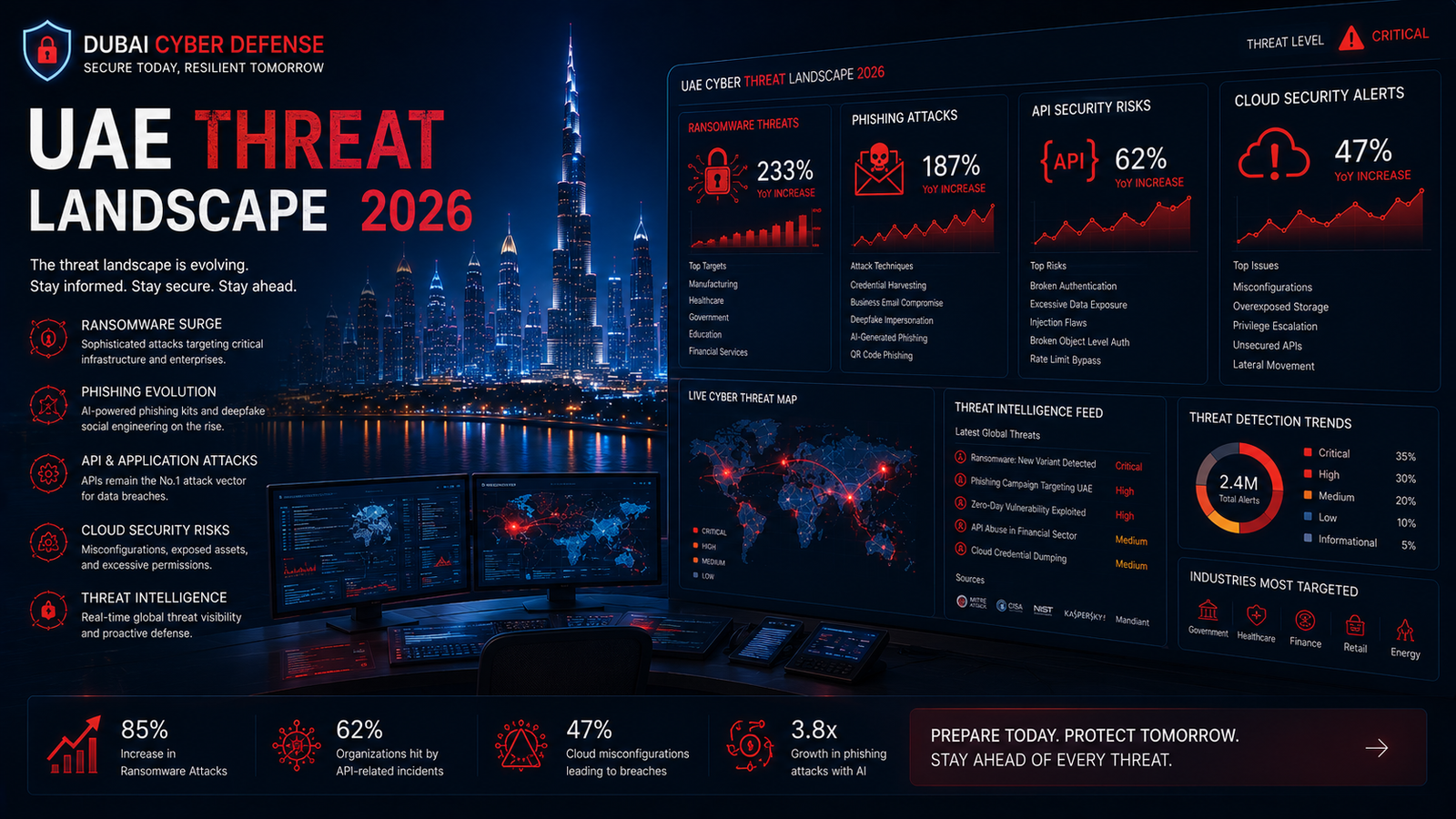
The 2026 Threat Landscape for UAE Businesses Explained
Jul 01, 2026
Introduction
Cyber threats are evolving faster than ever.
For businesses across Dubai and the UAE, 2026 is shaping up to be one of the most
challenging security environments yet. Attackers are becoming more sophisticated, more
automated, and more focused on exploiting operational weaknesses.
The threat landscape is expanding.
Ransomware groups are becoming more aggressive.
Phishing attacks are more convincing.
APIs are under constant attack.
Cloud misconfigurations remain widespread.
Insider risks continue to grow.
At the same time, businesses are more digitally connected than ever before.
That creates opportunity.
It also creates exposure.
Every cloud workload, employee device, third-party vendor, application, and API expands the
attack surface.
This makes understanding the threat landscape critical.
The goal is simple.
Know what threats matter most and prepare before they become incidents.
The Problem: Attackers Are Faster, Smarter, and More Automated
Modern cyber threats are no longer limited to isolated attacks.
They operate at scale.
Attackers automate reconnaissance, vulnerability scanning, phishing campaigns, credential
stuffing, and exploitation attempts across thousands of targets simultaneously.
This creates constant pressure.
Businesses are exposed even if they are not directly targeted.
Common top threats in 2026 include:
● Ransomware attacks
● Business Email Compromise
● API exploitation
● Cloud security misconfigurations
● Insider threats
● Supply chain attacks
The biggest challenge is speed.
Threats move faster than traditional security operations.
A single compromised credential, exposed API, or misconfigured cloud asset can become a
major breach within hours.
This creates significant risk for businesses with limited visibility.
The threat landscape rewards preparedness.
Weak security creates opportunity for attackers.
The Solution: Focus on Visibility, Detection, and Resilience
The strongest businesses prepare for modern threats with layered security strategies.
The first layer is visibility.
Businesses need clear visibility into users, endpoints, cloud environments, APIs, and critical
systems.
The second layer is detection.
Threats must be identified early through continuous monitoring, analytics, and automated alerts.
The third layer is resilience.
Businesses need strong recovery planning, access control, incident response, and containment
capabilities.
This is where cyber security Dubai strategies and SOC as a service UAE provide major
value. Continuous monitoring improves threat detection and reduces response time significantly.
Businesses should prioritize controls around:
● Identity security
● Endpoint protection
● Cloud security
● Data protection
● Threat monitoring
The strongest security strategies reduce exposure while improving response speed.
Preparation wins.
Real Numbers: Security Investment vs Threat Exposure
Approach Typical Annual
Cost
Business Impact
Minimal security
investment
AED 0–20,000 High threat exposure
Basic security program AED
30,000–100,000
Reduced attack surface
Advanced security
program
AED
100,000–300,00
0+
Strong resilience and
visibility
The numbers tell a clear story.
The cost of proactive security is significantly lower than the financial, operational, and
reputational damage caused by a serious cyber incident.
Prevention reduces long-term cost.
Resilience protects growth.
UAE-Specific Security Considerations
For businesses operating in Dubai and across the UAE, cyber resilience is increasingly tied to
compliance and data protection obligations.
Breaches involving sensitive information can directly impact PDPL compliance UAE and
broader data protection UAE requirements.
Key priorities for 2026 include:
● Identity security
● Cloud visibility
● Threat detection
● Incident response readiness
● Compliance readiness
Businesses handling sensitive customer or business data should treat cyber resilience as a
strategic priority.
Risk is growing.
Preparation matters more than ever.
Why FortyFi
FortyFi helps businesses across Dubai and the UAE strengthen cyber resilience through
practical security strategies designed for modern threat environments.
From threat monitoring and cloud security to incident response and compliance support, the
focus is on reducing risk before threats become business disruptions.
The team helps businesses improve visibility, strengthen controls, and build resilience against
evolving threats.
The objective is simple: help businesses stay ahead of modern cyber threats.
FAQ
What are the biggest cyber threats in 2026?
Ransomware, phishing, API attacks, cloud misconfigurations, insider threats, and supply chain
attacks.
Why are threats increasing?
Businesses are becoming more digital, connected, and complex.
Are SMEs at risk?
Yes. Attackers frequently target SMEs because they often have weaker defenses.
What security controls matter most?
Identity security, monitoring, endpoint protection, and incident response.
Does strong security help compliance?
Yes. It reduces breach risk and improves compliance readiness.
Is Your Business Ready for the 2026 Threat Landscape?
Cyber threats are growing faster and becoming harder to stop.
Businesses that improve visibility, detection, and resilience dramatically reduce risk.
The best time to strengthen security is before the next incident.
Message FortyFi today for a security assessment and prepare your business for the evolving
2026 threat landscape.