Web3 & Blockchain
Web3 Identity and KYC: Compliance for Dubai Crypto Platforms
Jul 01, 2026
Introduction
Dubai's crypto platforms must verify who their users are—even in Web3. VARA and
CBUAE mandate robust KYC and identity verification for all licensed virtual asset service
providers. For founders building decentralized platforms, meeting these requirements
without compromising user privacy is a real engineering challenge.
The Problem: Web3 Meets KYC Requirements
Crypto platforms must comply with strict identity verification rules, but Web3 was built
for pseudonymity.
Regulatory mandates: VARA requires identity verification for all users of licensed
platforms. CBUAE's Anti-Money Laundering rules apply to virtual asset transfers. PDPL
governs how personal data is collected and stored.
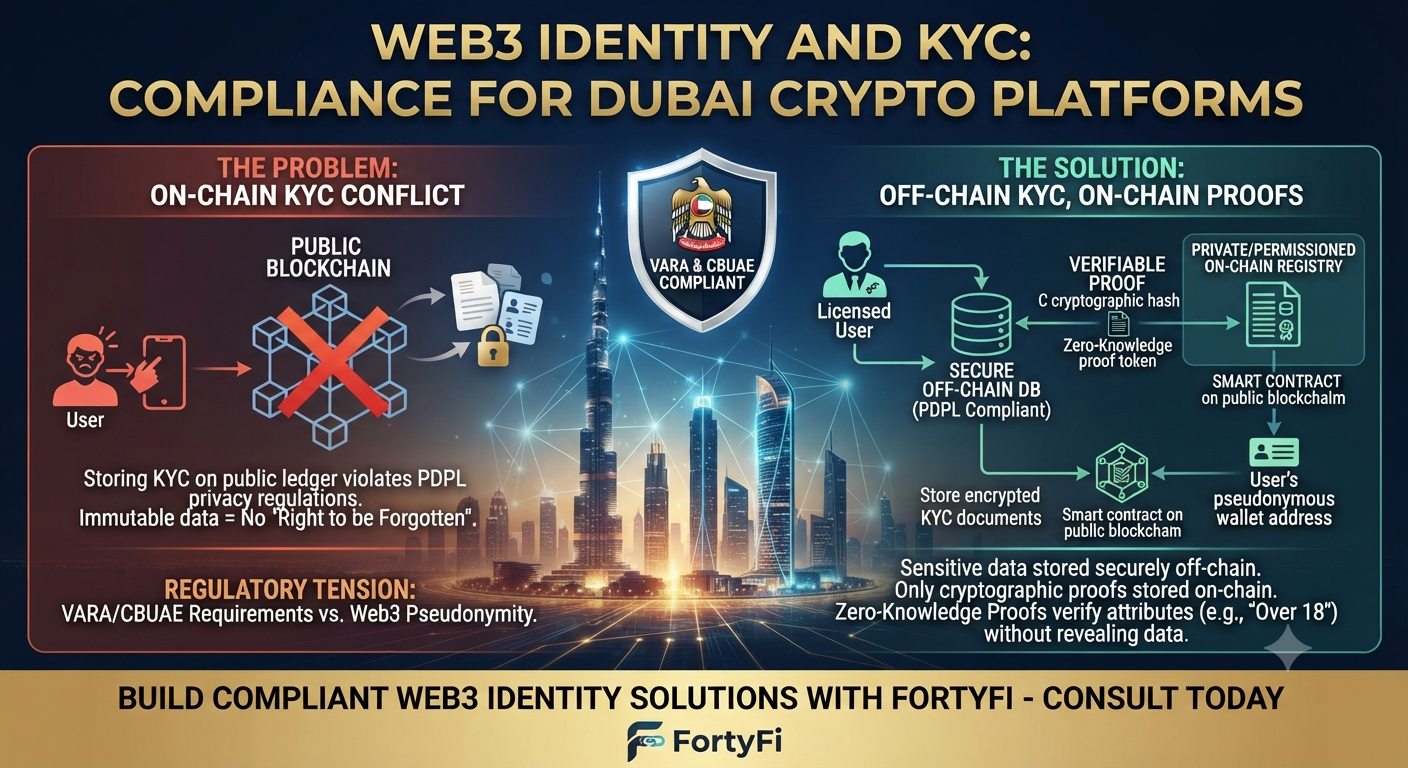
Architecture tension: Public blockchains store data permanently—but storing KYC data
on-chain violates privacy regulations. The technical challenge is verifying identities
without exposing sensitive information.
The Solution: KYC Off-Chain, Proofs On-Chain
The right architecture keeps sensitive KYC data off-chain while storing verifiable proofs
on-chain. Off-chain identity verification is done through licensed providers, storing
documents in encrypted, PDPL-compliant databases. Only cryptographic proofs of
verification are stored on-chain, enabling pseudonymous wallet addresses to be linked
to verified identities without exposing personal data. Privacy-preserving techniques like
zero-knowledge proofs can verify attributes (e.g., "over 18") without revealing actual
data.
Real Numbers: The Cost of Non-Compliance
Fines for non-compliance can reach AED 1 billion under CBUAE rules. Platforms
operating without proper KYC risk immediate suspension, while client onboarding
without proper identity checks can lead to criminal liability for MLROs.
UAE-Specific Considerations
PDPL requires personal data to be stored with proper controls—public blockchains don't
qualify. Data residency matters: user data must remain within UAE jurisdiction. VARA
expects documented identity verification procedures and regular audits.
Why FortyFi
FortyFi builds Web3 identity and KYC solutions designed for UAE compliance. We
design architectures that meet VARA and CBUAE requirements while respecting user
privacy and PDPL obligations.
FAQ
Can I store KYC data on-chain? No. Store data off-chain with proper controls; store only
verification proofs on-chain.
What are VARA's KYC requirements? All users must be verified with identity documents
and proof of address—similar to traditional financial institutions.
Does PDPL apply to crypto platforms? Yes. Any platform handling personal data of UAE
residents must comply with PDPL.
Fix Your KYC Architecture
Message FortyFi on WhatsApp for a free compliance review of your identity verification
system.