Cybersecurity
Zero Trust Architecture Explained for Dubai Business Owners
Jun 30, 2026
Introduction
The traditional security model was built on a simple assumption: once someone is inside the network, they can generally be trusted.
That assumption no longer works.
Modern businesses in Dubai operate in highly connected environments with cloud platforms, remote teams, mobile devices, third-party vendors, and distributed infrastructure. The traditional network perimeter has effectively disappeared.
This creates a major security challenge.
Attackers no longer need to breach an entire network through a single firewall. In many cases, they gain access through compromised credentials, unsecured devices, or weak access controls.
Once inside, they move laterally across systems and access sensitive data.
This is exactly why businesses are moving toward Zero Trust Architecture.
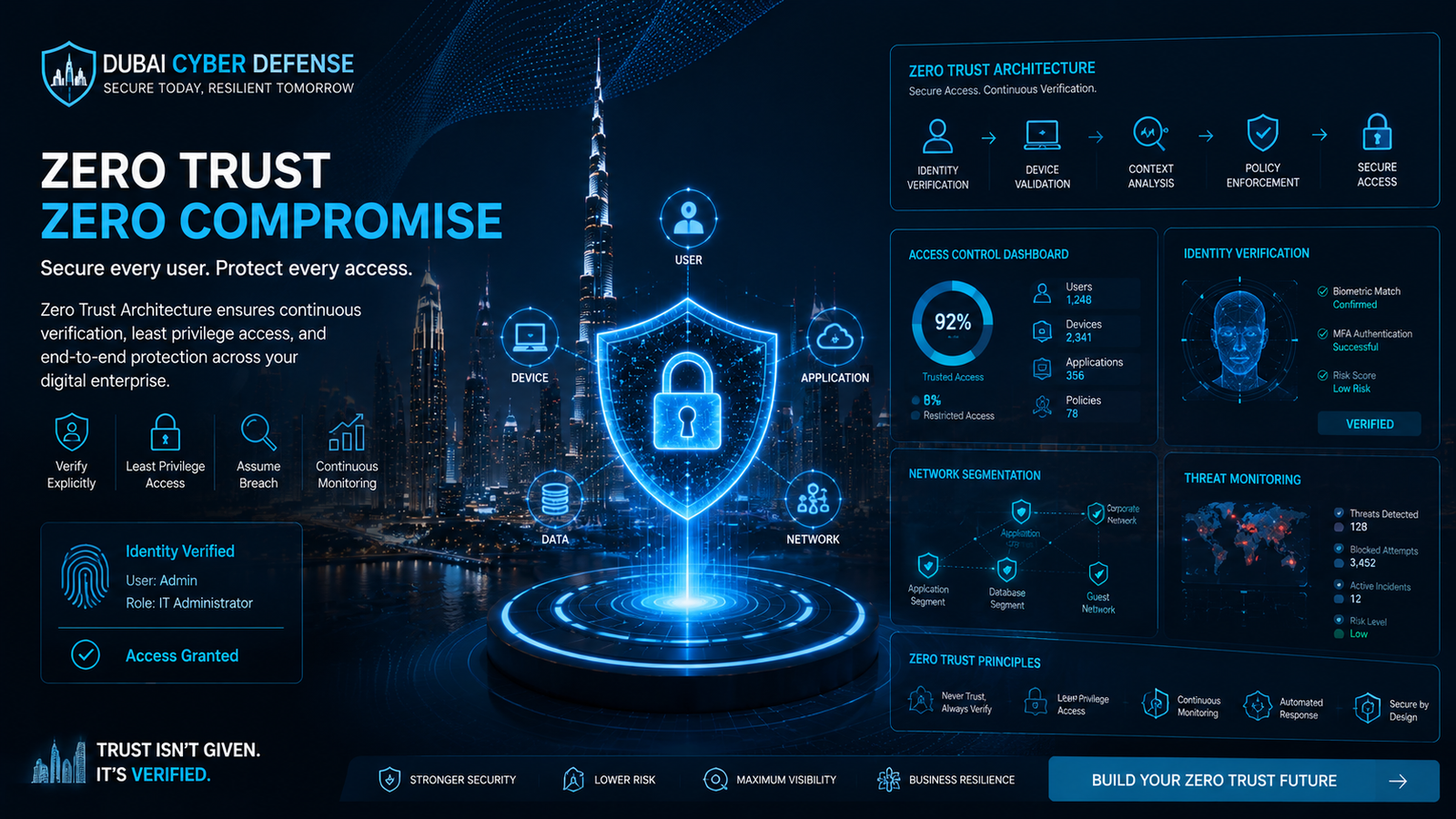
Zero Trust replaces outdated assumptions with a modern security model based on one core principle: trust nothing, verify everything.
The goal is simple.
Reduce risk by continuously validating access, users, devices, and activity.
The Problem: Traditional Security Models Are No Longer Enough
Traditional security relies heavily on perimeter defence.
Firewalls, VPNs, and network boundaries were designed to keep threats outside while allowing trusted users inside.
The problem is that modern threats often bypass the perimeter entirely.
Compromised credentials, phishing attacks, insider threats, and unsecured endpoints allow attackers to gain access without triggering traditional perimeter controls.
Once attackers enter, weak internal segmentation makes movement easier.
This increases risk significantly.
A single compromised user account can potentially expose sensitive systems, customer data, financial records, and critical business infrastructure.
For businesses in Dubai, this risk continues to grow as digital transformation accelerates.
Legacy security models struggle to protect modern environments.
The Solution: Verify Every Access Request
Zero Trust Architecture changes the entire security model.
Instead of assuming trust based on network location, every access request is continuously verified regardless of where it originates.
Users, devices, applications, and workloads must all prove legitimacy before gaining access.
This creates much stronger security.
Zero Trust relies on identity verification, multi-factor authentication, device trust, access segmentation, and continuous monitoring to reduce risk.
Access is granted based on least privilege.
This means users receive only the minimum access necessary to perform their roles.
This reduces the damage attackers can cause if credentials or devices are compromised.
For businesses implementing cyber security Dubai strategies, Zero Trust significantly improves protection against modern threats.
The result is stronger access control, improved visibility, and reduced attack surface.
Real Numbers: Traditional Security vs Zero Trust
Approach | Security Level | Business Impact
Traditional perimeter security | Moderate | Higher exposure to credential-based attacks
Hybrid security model | Strong | Improved control with moderate complexity
Zero Trust Architecture | Very High | Strong access security and reduced risk
The difference is substantial.
Traditional models focus heavily on perimeter defence.
Zero Trust focuses on continuous verification.
This makes it significantly harder for attackers to move through systems even after initial compromise.
The result is lower breach risk and stronger resilience.
UAE-Specific Security Considerations
For businesses operating in Dubai and across the UAE, access security plays a major role in both cyber resilience and compliance.
Strong access controls directly support PDPL compliance UAE by reducing unauthorized access to sensitive customer and business data.
Zero Trust also strengthens data protection UAE by improving visibility, access governance, and security monitoring.
Key Zero Trust priorities include:
● Identity verification
● Multi-factor authentication
● Device security validation
● Least-privilege access
● Continuous monitoring
Businesses with remote teams, cloud workloads, and sensitive data benefit significantly from this model.
Security now depends on controlling access everywhere.
Why FortyFi
FortyFi helps businesses across Dubai and the UAE modernize security architecture through practical Zero Trust strategies designed for real business environments.
From identity security and access management to monitoring and infrastructure segmentation, the focus is on reducing risk while improving operational security.
The team helps businesses build scalable security models that align with modern infrastructure and evolving threat landscapes.
The objective is simple: trust less, verify more, and reduce risk.
FAQ
What is Zero Trust Architecture?
Zero Trust is a security model that requires continuous verification of all users, devices, and access requests.
Why is Zero Trust important?
It reduces risk by preventing attackers from moving freely after initial compromise.
Is Zero Trust only for large enterprises?
No. Businesses of all sizes can benefit from Zero Trust principles.
Does Zero Trust replace firewalls?
Not entirely. It complements traditional security tools with stronger access control.
Does Zero Trust help compliance?
Yes. Strong access controls improve compliance and data protection readiness.
Is Your Business Still Trusting Too Much?
Modern cyber threats exploit trust.
Traditional security models assume too much and verify too little.
Zero Trust changes that.
Businesses adopting Zero Trust now will be far better prepared for future security challenges.
Message FortyFi today for a security assessment and discover how Zero Trust can strengthen your business.